Showing posts with label Something Dan Watched. Show all posts

Tuesday, November 30, 2010

Some Things Dan Watched: Possession & A Chinese Ghost Story


Sometimes I aspire to be a pretentious dick. Part of me sees myself (or would like to see myself) as a member of the cinematic literati, a man of impeccable taste who watches only the most austere, sophisticated films, while furrowing my brow in a manner indicative of my absolute seriousness and focus on critical analysis, possibly while wearing a smoking jacket and sipping on a glass of brandy. Yet despite my earnest forays, especially recently, into the cinema of revered auteurs such as Jean-Luc Godard, Abbas Kiarostami and Hou Hsiao-Hsien (and a very real appreciation of those filmmakers), at the end of the day I'm a basic kind of guy. My interest in film is far more personal than academic, and though I have some interest in different branches of film theory, I tend to be biased towards films that work directly on my emotions, or those that go for bold stylistic gestures, rather than those that appeal to my intellect, or emphasize stylistic restrain and maturity, or are meant to be viewed through certain theoretical frameworks.

Which is my longwinded way of explaining why I enjoy weirdo cult movies so much despite my aspirations to serious cinephilia. I'm still hoping/planning to include some more serious-minded films in upcoming Something Dan Watched posts, but for right now it seems that it's turned into a forum for me to recommend bizarre, slightly obscure films that I enjoyed. And today I have two for you.

Possession stars Isabelle Adjani and Sam Neill as a married couple on the skids; she's leaving him for another man, and he is not taking it well. Now, I'll try to step lightly here because I don't want to give too much away, although I'm not sure how much you can spoil a movie that doesn't make a lot of sense. The husband moves out, but discovers that the wife is neglecting their young son. The husband confronts her lover, a flamboyant European sex machine, but it devolves into an awkward fist fight. He confronts the wife and it devolves into... her trying to slice open her neck with an electric knife, and he matches her by slicing up his own arm. Then he meets his son's schoolteacher, who looks exactly like his wife with different hair, so naturally he starts an affair with her. And he keeps on having weird confrontations with his wife that culminate in things happening like her stepping in front of a tow truck, causing it to swerve and send the demolished cars it was hauling flying onto the sidewalk.

I'm just talking about the first 20 minutes or so, before the movie really gets weird. I'll stop talking specifics now and just say that the movie then rushes headlong into mystery, murder, grotesqueness, and some very, very transgressive sex, all with an unexpected supernatural bent (although nothing to do with demonic possession, as the title might lead you to expect). And it may culminate with the apocalypse. Or something.

The early scenes of Possession threw me; it seemed pitched at too high of an energy level, with a lot of overacting and melodramatic dialogue. What I first thought might have been bad acting and writing turned out to be a deliberate stylistic choice. Possession sustains a manic energy for its entire 2 hours, with nowhere to go but up: you think you're already at a 10, then you find out that this one goes to 11. It's main goal seems to be to do whatever it takes to get a reaction out of the audience, to put them on edge or confound them at every turn. Actors assume random ticks, spasming and flopping around during some scenes for no discernible reason. The camera work is just as intense and overly-stylized: for example, if a character sits down in a rocking chair, the camera will rock with them. The plot grows increasingly bizarre and audacious, veering frequently from broad comedy to melodrama to freakish horror. And when that's not enough, it'll throw everything at you at one, as in a scene where Adjani suddenly begins screaming and flailing around, before inexplicably secreting weird, viscous fluids.

I have to praise the acting, especially the lead roles. The behavior of the characters grows increasingly erratic and inexplicable during the film, yet Adjani and Neill ground it in a certain internal consistency while still relishing every exaggerated second of it. I was familiar with Adjani's work from Francois Truffaut's The Story of Adele H and Werner Herzog's Nosferatu, so I knew she could play madness and handle herself well amidst all the weirdness. Neill, on the other hand, I'm more used to see play buttoned-down straight men, so it's a real treat seeing him go for broke.

I have never seen another film by director Andrzej Zulawski, but I may have to seek one out. Possession is an inspired work of insanity, a seemingly endless treasure trove of horrific surrealism. It moves with the relentless pace of a nightmare, following its own twisted logic that doesn't make rational sense but is persuasive nonetheless. Lest I'm making this sound like a work of empty provocation (not that provocation doesn't have it's place), I suspect that the film is a genuine attempt to deal with the ugly emotions of a messy divorce, translated into visceral, horror movie terms.


The next movie I wanted to mention has little in common with Possession, despite also being a horror film (ish), except for a similar desire to cram as many ideas into each shot as humanely possible. I'm not nearly as enthusiastic about A Chinese Ghost Story, but I definitely give it a strong recommendation to fans of 80's horror/comedies. The best description I can give it is that it's like a kung-fu version of Evil Dead II. The plot concerns some silliness about a goofy ne'er-do-well who falls in love with a ghost and has to do battle with her evil ghost family, but that's all just an excuse to wow the audience with a bunch of exuberant, imaginative special effects.

You get stop-motion ghouls, a giant tongue monster, an army of the dead, a POV shot from a ghoul traveling down someone's throat, and lots of berserk supernaturally enhanced martial arts scenes. Any time the movie stops to focus on character or exposition the energy flags a little too much, but all the flipped out action makes up for the dull spots.

The reason I sought this film out, oddly enough, is because Renny Harlin mentioned it on the epic length Nightmare On Elm Street documentary Never Sleep Again. Apparently it was a major influence on Harlin when he made part 4 (The Dream Master, my favorite of the series), and it clearly took inspiration from A Chinese Ghost Story's crazy, inventive special effects.




Monday, November 22, 2010

Something Dan Watched: Madhouse

Just a quick one for you. Over the weekend, I showed my brother Madhouse (a.k.a. There Was a Little Girl, the onscreen title on my DVD copy), a little gem of an early 80's slasher movie that I discovered earlier this year. I talked about it briefly last month, but thought it was time to say just a little bit more about one particular element of the film.

The story, which shares a few plot points with Happy Birthday To Me (coincidentally, I believe, as both films came out the same year), involves Julia, a young teacher at a school for the deaf. Her abusive, crazy, deformed twin sister breaks out of the mental hospital a few days before their birthday. And soon, people close to Julia are vanishing or dying, at the hands of a mysterious killer with a vicious pet dog, who is planning a special birthday surprise.


There's a lot to like in Madhouse, which for a sleazy, early 80's slasher is uncommonly well shot, written, and acted. The clincher, what makes it a minor classic in my esteem, is the way the film (an Italian production that does a good job passing as American) works some giallo-style weirdness into the slasher template. This includes odd touches such as the killer's choice of murder weapon (dog), the killer's fondness for singing nursery rhymes, and the heroine's job working with deaf children (no offense to the kids, who are all sweethearts, but there's something vaguely unnerving about deaf children trying to speak).

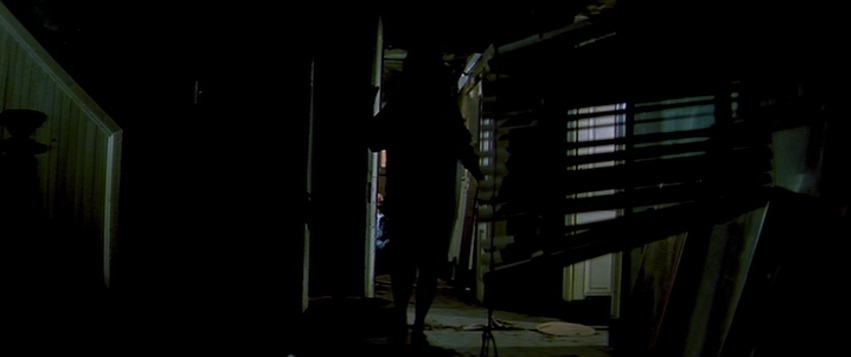
One especially weird detail that sticks out for me every time is that, although I'm not 100% sure about this, I swear in one scene the killer is played by a puppet. Tell me what you think:


It's probably hard to see what I'm talking about without seeing the way "she" moves in the shot, which strikes me as looking somewhat weightless. Here are a few stills of the sister in other scenes for comparison:


The thing is, I cannot figure out for the life of me why they couldn't have used the actual actress in the shot. Is it because they didn't think a person could leap into the frame fast enough? Was the actress not available? Is it because (and maybe I'm getting into mild spoilers here) there's some doubt as to whether the evil twin is really the killer, and the filmmakers wanted to make something about the scene feel "off"?

I like that last theory the best, but I doubt it's true. There are a few other (more obvious) puppets in the film, and they seem more like products of budget limitations than intentional surrealism. Take for example these corpses:


And this dog head:


Yet, my point is that no matter the intent of the twin-puppet, the shot of her stabbing the maintenance man adds to the dreamy, creepy quality I admire about the film.

Anyone looking for a good slightly off-the-beaten-path slasher movie should check this one out.

Monday, November 15, 2010

Something Dan Watched: Enter The Void

Well, considering that I've recently purchased a box set of Hou Hsiao-Hsien films that I'm doggedly working my way through, I was hoping my next Something Dan Watched post would cover something a little more prestigious or, you know, respectable. Instead, less than a week after covering Liquid Sky, I find myself discussing another trippy, drug-conscious, offbeat cult oddity: Gaspar Noe's Enter The Void, which just came to D.C.'s new West End Cinema this past weekend.

Enter The Void isn't really about its plot, so much as it is about its style, but let me briefly synopsize anyway. It tells the story of Oscar, an American drug dealer living in Tokyo with his younger sister. One night, a drug deal goes bad, and Oscar ends up getting shot to death by the cops. For more movies that would be the end, but things continue as Oscar's soul leaves his body. It experiences a strange journey, watching over Oscar's friends and family, reliving the formative experiences of his life, and eventually SPOILER being reincarnated as his sister's son. Or, as the film hints, this all may just be a hallucination Oscar experiences as he lays dying on the bathroom floor of a sleazy club known at The Void.

Like I said, though, it's not so much about the story as it is about the way Noe tells it. Enter the Void is the most stylistically rigid and all-around ballsy film I've seen in theaters this year. The whole film is shown as Oscar's subjective experience: the early scenes, when he's alive, are filmed from Oscar's POV, as though the camera was his eyes (this includes frequent black frames to suggest blinking, and a spectacular sequence where he does some heavy hallucinogens and trips for a while); after he dies, the camera assumes a weightless, god's-eye-view perspective as it flies around Tokyo, passing through solid objects like walls and people, as Oscar watches over the people from his life; the life-flashing-before-his-eyes scenes are filmed from directly behind Oscar, never showing his face, almost like you might see in some video games.

The only previous Noe film I've seen was his controversial Irreversible, which was so nihilistic and intent on rubbing the audience members' faces in filth and human misery that it was almost comical... yet I still respected its ambitious visual style and structure, in which the scenes were show in reverse chronological order, and each was staged as one continuous, elaborate take. Enter The Void spectacularly brings that one-take style to its most insane extreme (some shots are designed to appear "continuous" for what seemed to me to be nearly a half hour or so in length).

I've read several valid complaints about this movie, criticizing that it is style over substance, that the actual story of the film isn't as interesting as the visuals, that Noe includes too much of his trademark human degradation and miserableness. Those folks have a point. The screenplay never much bothers for subtlety (minutes before Oscar's death, he and a friend discuss the Tibetan Book of the Dead, and everything they discuss directly correlates to what happens to him in death) and I do think the exhilaration I felt during much of the filmed flagged about 90-minutes-ish in when it focused for too long on Oscar's friends and family in the aftermath of his death. Yet there's something about Noe's balls-out, go-for-broke style that redeems these flaws. Although I've gathered that Noe shares my lack of religious beliefs, and that the spiritual components of the film are ultimately just Oscar experiencing the "ultimate trip," as chemicals flood his brain as he dies, there's something about the way Noe conflates death, spiritualism, hallucination, subjectivism, reincarnation, etc., as different ways of looking at the same thing that makes the film energizing. It should be a downer but it feels like a positive experience.

Many will (perhaps rightly) hate this film, but those who appreciate bold aesthetic statements will find it was at least worth watching. (Also, I'm pretty sure this is going to be a cult item amongst stoners for years to come.) The best I can describe Enter the Void: it's like a four-way collision between Wings of Desire, 2001: A Space Odyssey, Lady in the Lake and a Stan Brakhage short, and yet it's still not quite like anything you've seen.

Thursday, November 11, 2010

Something Dan Watched: Liquid Sky

"Your Vice is a Horror Movie Marathon and Only I Have the Netflix Queue" has finished its third consecutive year and, as per usual, fatigue has set in. I blogged 60 horror movies last month, regardless of whether or not I actually had anything to say about them. You start to get a little tired of writing after a while.

Last year, I let the blog fall into inactivity for several months afterward, and I would not like to see that repeated. What, then, to do? A Piece of the Action, while still an interesting idea for an ongoing column, turned out to be too time-consuming to keep doing. (And, frankly, I'm not happy with how either previous post turned out). If it ever returns, it will be in a much truncated fashion. I had ideas for two other articles, one a series and the other a one-time deal, but both involve horror movies and I'm a little burned out on that topic.

So the idea is this: I'm just going to make an effort to write little capsule reviews about movies I've recently seen, when I feel I might have a few thoughts about them. I call it Something Dan Watched, and I plan to do one weekly-ish, depending on if and when I watch something remarkable.


"Remarkable" as in something worth remarking on, not necessarily something I thought was good. And, boy, did I watch a remarkable film this week. Loyal readers (hahahahaha I crack myself up) will have noticed by now that I have a certain affection for movies that blur the line between "bad" and "good"; problematic, deeply flawed movies that are also weirdly interesting in unexpected ways. For me, this often turns out to be horror movies like I Know Who Killed Me, which are grossly deficient in terms in terms of script/plot/acting/coherency/etc, but have an off-kilter aesthetic worth or uniqueness about them. What's "bad" about the films is intertwined with what makes them "good" or interesting, and not just in a "so bad it's good" way.

1983's Liquid Sky is a bad movie in the sense that it is awkward, often poorly written and acted, narratively inept, and chintzy in its style... but it's also an interesting and provocative as a work of art. It's primary focus is on Margaret, a young woman and aspiring actress/model who likes to go to the New Wave clubs dressed in outrageous, androgynous outfits obviously influenced by David Bowie. She hangs out in a sleazy, drug addled world of low-rent performance artists and fashionistas, and much of her time (and the time of her colleagues) is spent trying to get high/trying to find the next score. She's dating another woman but considers herself bisexual (or maybe pansexual), and the movie is loosely structured as a series of her sexual encounters.

I should mention at this point that a tiny flying saucer has landed above her apartment, controlled by unseen, heroin-addicted aliens that discover they also enjoy the chemicals released in the human brain during orgasm. Oh, and people just sort of keep showing up and raping Margaret, and at the moment of orgasm the aliens shoot crystal blades into the rapists' brains, killing them and extracting the orgasm chemicals. Visually, this is all conveyed in what I assume are alien POV shots that at first appear as a proto version of Predator heat vision, then turn into colorful abstractions akin to the finale of 2001: A Space Odyssey. Realizing that plot is maybe not well conveyed via the medium of acid trip, the filmmakers make room for a subplot about a German scientist who watches all this from across the street through a telescope and helpfully explains the story to a woman who is trying to seduce him.


So it's got a certain charming batshit quotient to it that we all love in our cult movies, but let me adjust your expectations before you run out to find a copy. I'm fairly certain most people would, reasonably, not have any appreciation for Liquid Sky. It's an awkwardly made low budget film, complete with tin-eared dialog, flat line readings, lots of bungled shots where actors are clumsily placed in the frame, and shots that go on forever not because the filmmakers were attempting something complex but because they didn't have time for multiple setups.

That said, I have to confess feeling admiration, or feeling something, for the film's ambitions, and for certain elements of its style. It may be all those negative things I said, but it's also bold, trippy, funny, bizarre, unique. At its best, it feels like somebody stitched together pieces of a talky, pretentious art movie with a near unwatchable, microbudget sci-fi/horror movie (I know that doesn't sound like a compliment). This schizophrenia extends itself thematically as well; the film seems to have a lot to say and wants to say all of it, even if those things don't have much to do with each other. It's a film that is in turns about sexuality, drug addiction, a celebration of drug consciousness, a critique of the New Wave/art scene it depicts, a forum for performance art, a commentary on the objectification of women in art and the media, and much more.

If there's a central theme to it all, it's about the way that poor Margaret, because of the way she looks and dresses, is treated by everyone she meets as their own personal sex toy. No one respects her or what she says; whether by force or by coercion, everyone feels entitled to fuck her. Two of the film's most memorable sequences deal with this: one in which a crowd of gawkers and hanger-ons at a fashion try to egg her into having sex on camera, their voices being digitally lowered in a nightmarish way; another where Margaret gives a monologue while applying glow-in-the-dark paints to her face.

Still, the most noteworthy element of the whole film may be Anne Carlisle's performance, who co-wrote the film in addition to starring in it. She's not only Margaret, but in a bizarre dual performance also plays Jimmy, an antagonistic drug addict who is, yes, a man. Carlisle's performances aren't technically polished, but they are at times transfixing (which is why she fits so well in this film). Physically, she resembles a mix of Bowie and Tilda Swinton, with all the androgyny that implies. She's somehow both sexually alluring (in an unconventional way) as Margaret, and oddly convincing and poised when playing a man. This sexual tension climaxes, as it only could in a movie this singular, with Margaret blowing Jimmy. I could be wrong, but I suspect an actress performing oral sex on a male version of herself is a cinematic first, and in this case a perfect summation of Liquid Sky's themes of sexuality and gender .