Hey, y'all. This year's horror movie marathon happens to be coinciding with some major life events, and I'm a little concerned I won't have time to watch as many this year. As a result, partner-in-crime Mr. Subtlety convinced me to go ahead and get an early start to knock off a few of the films I wanted to see. Below are a handful of horror flicks I watched the last week or so of September. I will be back soon with the official kick-off film for this year's marathon, The Tall Man.
Piranha 3DD
I kinda like Alexandre Aja's Piranha 3D, but it was no great shakes. I won't go so far as to call it a disappointment, but it definitely could have had a lot more fun with what it was trying to do. It might be that Aja was the wrong guy for the job; his previous films didn't exactly indicate a subversive sense of humor.
Now here comes a pointless, barely-released sequel that no one could have possibly asked for, but I felt mildly hopefully because they hired the right men for the job: the director and writers of those stupid Feast movies. If you haven't seen them, they are silly, lightweight exercises in over-the-top effects and bad taste that happen to be just fun enough to be worth watching. Seems like a perfect match for a Piranha sequel.
3DD isn't really an improvement; in fact, I'd rank it about equal. It's biggest mistake, in some ways, is to start with footage from the first film. Whatever 3D's faults, there was a real size and scope to the giant piranha bloodbath at the end of the film that this sequel, which looks like it was made for about 1/4th the budget, could never hope to match. When 3DD finally reaches it's big finale (which one character claims will make the events of the first film "look like an appetizer"), it's largely underwhelming because it basically consists of 30 people thrashing around in a swimming pool.
The film makes up for these shortcomings by having better individual scenes that go way more over-the-top than the original. We get Gary Busey biting the head off a piranha and spitting it into the camera, a piranha coming out of a vagina to bite off a dick, a cow farting explosive piranha eggs, Ving Rhames with piranha-killing shotgun legs, gratuitous vomit, full frontal female nudity, a piranha up the ass, hilarious child murder, and a bunch of self-referential silliness where David Hasselhoff plays himself and sulks about how low his career has sunk. It's not exactly a laff riot, but for this kind of crap, it'll do. Director John Gulager (son of Clu, who makes a cameo) has a nice eye for striking visuals and sight gags, and even if he never crafts a classic set piece, a few of the minor ones are worthy.
Rating: C+
Necronomicon: Book of Dead
Produced and partly directed by Brian Yuzna (who made reliably fun Stuart Gordon-lite type movies until the mid 90's, when his films suddenly turned unwatchable), this is an anthology film based on the stories of H.P. Lovecraft. Each of the 3 parts is directed by a different filmmaker: Yuzna, Christophe Gans, and some Japanese dude I've never heard of. Yuzna also directs the (pretty stupid) wraparound story, which involves Jeffrey Combs (in ridiculous makeup) as Lovecraft reading the stories and discovering real life spooky shit.
I've never seen a Lovecraft adaptation that really quite nails what's special about his works, and maybe that's because Lovecraft had great ideas but wasn't a very good writer. Stuart Gordon has probably fared the best with his several adaptations, taking some of Lovecraft's ideas and wedding them to gory, over the top, satirical stories. Necronomicon is somewhat along those lines, though maybe more self-serious than Gordon's films, and honestly does a better job than most adaptations at using Lovecraft's premises and trying to evoke their sense of incomprehensible horror. I mean, just a few weeks previously I watched a supposed Lovecraft adaptation called The Unnamable, which was about (I shit you not) a bunch of college students in an old house with a scary monster. They pay some lip service to a few Lovecraftian themes, but basically it could be any other cheap, shitty 80's horror movie. Necronomican at least has terrible ancient beasts and people suffering unfathomably torturous fates and whatnot.
It's not a great anthology film. It's a little cheap and awkward in places, Gans' segment is a big of a slog to a cool conclusion, and the wraparound story is pretty corny. But I still think it's more clever, fun and ambitious than it has any right to be, and definitely worth it for horror fans.
Rating: B-
Charisma
Kurosawa Kiyoshi has a style that I appreciate. He creates richly atmospheric, unsettling, kinda depressing movies, often by using long, slowly developing takes with minimal sound effects, dialogue or score. He's best known for doing horror movies (I'd say my favorite is Cure), but even when he does an ostensible drama like Tokyo Sonata, he strikes much the same tone. I wasn't sure if Charisma was going to be a horror movie going into it, and it didn't seem like it was for a while, until it slowly becomes one.
The story involves a mysterious tree named Charisma that seems to be poisoning the woods around it. The locals are infatuated with the tree, with some wanting to destroy it, and some wanting to protect it. And what starts as a slow, moody, surreal drama slowly escalates into something more terrifying. Kurosawa's use of violence in this film is striking; there's something shocking yet deadpan and matter of fact about the townspeople's eventual murders that maximizes the impact. The murder is almost... mundane, no more exciting than anything else that happens in the film, which makes it more disturbing.
Though I wouldn't quite rank it with Kurosawa's best, if you like his style, you'll like Charisma. It uses its slow pace to lull you and insinuate itself onto you, before slowly bringing the hammer down.
Rating: B
Wake Wood
Wake Wood has something of a classic horror story set up, with a nice visceral twist to it. It concerns the grieving parents of a dead girl who discover that there may be a way to bring their daughter back... but only for 3 days, and at a dire price. The film nicely exploits the emotional element of the story while not shying away from from disturbing the audience on a graphic level. The ordeal of resurrecting their daughter leads to some seriously messed up shit, and suffice it to say that the film is chock-a-block with bizarre birth imagery. Although I would have preferred a more elegant visual style, and the story doesn't live up to it's full potential (I think they could have come up with something more clever then having the kid kill a bunch of people), it succeeds at adding a lot of unnerving details and twists to what might have been an unsurprising story.
Rating: B
Absentia
Without spoiling too much, Absentia has a story with an almost Lovecraftian hook, yet what's fascinating about the film is the way it mostly eschews the larger implications in order to present a smaller, more intimate drama. Instead of the fear of some ancient a terrible beast beyond comprehension, it's about the fear of a loved one vanishing with no explanation, and how we deal with trauma when we don't have closure. There is a monster in this film, and there is an overarching horror-movie plot, but much of the time the film is focused in on the characters and how they are emotionally handling an increasingly bizarre and tragic situation. Considering its low budget, the quality of the filmmaking and the performances is quite impressive (although a little more money for special effects would have helped). Absentia is way too slow for someone looking for gore and special effects, but for those of us willing to slow down to its speed, it's surprisingly chilling examination of some difficult emotions, and the horror that it slowly builds is genuinely disturbing.
Rating: B
Resident Evil: Retribution (in IMAX 3D)
Once upon I a time hated the Resident Evil movies, but I've come around on them. Now, I've grown to love how bad they are. Beginning with an action scene shown backwards and in slow motion, and ending with humanity's last survivors holed up at the White House to fight off a monster invasion, RE:R is a treasure trove of nonstop silliness. No one can cram a movie full of so much nonsense like Paul W.S. Anderson; it's all corny dialogue, inconsequential plot developments, interchangable characters and action scenes highly stylized to the point of self-parody, all encased in a ludicrous story involving zombie apocalypses, clones, elaborate computer simulations, evil robots and under-water secret evil villain lairs.
The clincher is just how hard Anderson tries; he is honestly trying to make a fun movie, filled with action and plot twists and whatnot. Technically speaking, I think the man has talent: the action is cleanly filmed and edited, shots are nicely framed, color is used well. But whatever talent he has, it's all wasted on ridiculous stylistic gimmicks and a screenplay that would seem juvenile to a 13-year-old boy. Word is that the next one (part 6) is set to be the last, and you can bet I'll be there with bells on.
Rating: On the so-bad-its-good scale, I'd say a B+. On a more objective scale, I'd say a D.
Monday, October 1, 2012


Wednesday, September 26, 2012
Guest Post: To Criticize or Not: BELLFLOWER and Misogyny in Art
2011’s
BELLFLOWER is an interesting bird (…you know, one of those
movie-birds). It’s an undoubtedly intriguing, stylish, and well-directed
movie. The basic plot of the first half or so of it, quoted from the AV
Club because I’m lazy and they did a good job, is as follows: “[Writer/Director
Evan] Glodell stars as [Woodrow], the sweeter half of a pair of
Wisconsin natives who moved to California and settled into an
uncomfortable rut. He and his puckish partner [Aiden] (Tyler Dawson)
have shared an obsession with The Road Warrior since
childhood—in particular, with the beefy, mask-wearing wasteland warrior
Lord Humungus—so they spend their time assembling a homemade
flamethrower and dreaming of the car that will make them kings of a
post-apocalyptic future they profess to believe (and may actually
believe) is on its way… They spend their days in filthy apartments and
their nights at house parties or bars where grasshopper-eating contests
count as entertainment… Much of the film’s first half concerns the
romance between Glodell’s protagonist and the winner of one of those
grasshopper-eating contests [Milly] (Jessie Wiseman), a sweet-seeming
woman who warns him, during a spontaneous trip to Texas, that she’ll
probably end up hurting him.”
The AV Club doesn’t go into the second half, but it goes something like this: Milly does hurt him, he devolves into something between extreme depression and violent madness, or something encompassing both, finds a box he has labeled “Milly’s Shit,” goes to her house, flame-throwers it in her yard, and catalyzes a series of violent events that include the tattooing of Woodrow’s face in retaliation while he lays unconscious, the seemingly random suicide of Milly’s friend, the brutal rape and mutilation of Milly, and her return to him. Only wait, it didn’t happen, Woodrow and Aiden are just sitting on the beach burning Milly’s shit sadly. Woodrow’s not the Lord Humungus he dreams of, the one Aiden rants somewhat provocatively about embracing.
It’s that encouragement of embracing one’s evil, cruel side in a movie that displays a considerable amount of overt violence against and sexual violation of women that has more than a few people decrying it for being misogynist. Keith Phipps of the AV Club wrote that “after a point,” the film becomes “a film about men who hate women, and it comes awfully close to endorsing that point of view.” In response to this, film critic Glenn Kenny wrote, that “it doesn't ‘come close’ to endorsing that point of view, it absolutely embodies that point of view, it can see no other possibility but that point of view, it IS that point of view.”
A pretty lengthy debate about the issue between Dan and myself made me really delve deeply into the issue of misogyny in movies and other art forms, and a few questions in particular: if a movie’s characters or even themes are misogynist, does that make the movie misogynist? How seriously are we supposed to take a movie’s message or themes as being faithful to the way the artist sees the world, or a statement they’re trying to make about it? Where is the line drawn between a moral issue and an issue of taste, and where does misogyny fall? Do movies (or does art in general) have any responsibility to not cross certain lines, moral or tasteful?
Before I start, I feel like I need to disclaim myself by saying that I’m not one of those people trying to jump on every slight against a woman in any story or piece of art and yell “MISOGYNY!”, as if ill-will toward or negative portrayal of a person should never be considered, even conceptually, if that person happens to be female. I’m also not trying to be one of those women who is purposefully callous about loaded subjects such as domestic violence and rape, and all but sanctions violence and rape in the name of coming across as contrarian, or not easily ruffled, or “one of the bros” (and in any case, hopefully the bros in my life aren’t the raping and pillaging type).
With that said, my initial reaction to criticisms of misogyny in BELLFLOWER was that the film definitely does depict violence perpetrated against women, and women being evil bitches, but I attributed that to the characters themselves more than to their genders. I mean, it's easy to point a finger and say "You made a character that was both male and violent, and that violence was directed towards a woman! You think women are inferior and deserve to be violated!" But if the traits can be attributed to their personality more than they seem tied to their gender, I say give it a rest. Sometimes men in some movies are going to perpetrate violence and domination over women. But even if the men themselves are misogynist, just because they happen to be, doesn't mean the film itself is pushing a misogynistic message. But that only answers my first question, if a movie’s characters or even themes are misogynist, does that make the movie misogynist? I say no.
But the case doesn’t close there, because I think it’s also important to consider the artist’s intent in communicating what and how he/she does. That’s the second question: how seriously are we supposed to take a movie’s message or themes as faithful to the way the artist sees the world, or a statement they’re trying to make about it? Are the filmmakers condoning the actions or thoughts of the main characters (Woodrow and Aiden, in this case), or presenting them honestly and/or neutrally, perhaps laying them out without judgment, if not outright condoning their actions? It’s always an ambiguous issue, since the artist’s intent isn’t always clear. And if they outright fail to communicate what they intended to communicate, the issue isn’t whether they made a misogynist movie because of wanting to communicate misogynist ideas, it’s whether a movie can be considered misogynist (or any other term that implies a moral or ideological stance or judgment, one that you’d think would require a movie to be making a statement in order to qualify) if it’s “misogynist by accident,” because of what it accidentally says or fails to say. For a movie to qualify as misogynist, does it have to be overtly taking a stance on its characters and ideas, and does that stance have to be intentional? I don’t have clear-cut answers, but my initial feeling is “probably yes.” For example, take what Keith Phipps, quoted previously, wrote: “…and while there’s something to the way the film presents its heroes’ descent into ultra-masculine hobbies and knee-jerk violence as gross overreactions to their troubles with the opposite sex, it doesn’t have a firm enough grasp on its characters, or strong enough actors, to carry those ideas across” (http://www.avclub.com/articles/bellflower,59936). This description more implies a failure to get across their message so that it fell short, not a "wrong" moral stance that the filmmakers took or that the film itself advocates. It’s such a slippery slope to start slapping labels loaded with value judgments of virtue on art because of the themes it portrays, that I sort of feel that serious labels such as “misogynist” or “racist” or anything that carries the weight that those terms do should be reserved for pieces of art that make a clear, and clearly communicated, ideological or moral statement. Then it’s OK to judge that ideology or moral stance. But to judge a story, presented as nothing more than a story, an honest if somewhat brutal portrayal of something outside the realm of normal life or mentality? Less of a clear cut, even if the film is ambiguous, either purposefully or because of shoddy craftsmanship.
So let’s say that this is true, that the film does have to purposefully take a stance or endorse a message to be misogynist. Does BELLFLOWER? Kenny, the other film critic cited earlier, says yes; in his blog post about the movie (which can be found here: http://somecamerunning.typepad.com/some_came_running/2011/08/the-hipster-beardo-patriarchy.html), he claims that the movie was made for “the ball-flappin' PBR-swillers who are this film's ideal audience and sort-of subject matter,” and goes on to describe the kind of fucked-up attitudes they embody. But in reading his take on it (I’m not going to copy-paste it all; you can go read it at the link above for reference), I did not see a logical argument, or really any argument at all, that would support his notion that the film embraced the kind of sick attitudes its characters displayed. He talks about how ridiculous and messed-up those attitudes are, then goes on to describe another, unrelated movie that he thinks is also misogynist. But by the end of the review, I still couldn’t figure out why he thought what he did except for that he was patently offended that those characters existed and that the filmmakers had the audacity to think that he might enjoy watching their film, because it would make him a “ball-flappin’ PBR-swiller.” So I’m going to now do what Glenn Kenny didn’t, and tell you why I think “misogyny” is a little too grave a label for this movie in this regard.
In BELLFLOWER, for instance, Woodrow viciously assaults Milly, narrated off-screen by Aiden describing how you need to dominate women for them to respect you, embrace and become your inner “Lord Humungus,” a scene that ends with with the woman he just raped and mutilated embracing him. It definitely plays like a misogynist fantasy. But it's kind of set up that Aiden is an asshole and Woodrow is mentally unstable (not only for the obvious reasons, but also seen in the way he gets so instantly attached to and in love with Milly), so I don't think you're supposed to take the "Lord Humungus" speech at the end, where he talks about domination, as a serious message the movie is trying to portray and push on its audience. Especially since in the end, that fantasy is implied to be nothing more than that—a fantasy—and not real; it’s just a vivid glimpse into the state of Woodrow’s mind. He’s an unreliable narrator, and even if we are supposed to empathize with him simply by virtue of the fact that he’s the main character, I don’t think we’re supposed to take his thoughts as healthy or morally right. This is further affirmed by the fact that Milly is portrayed in a rosy manner in the first half of the movie, but as a completely unsympathetic bitch in the second half. But again, this is all through Woodrow’s eyes; of course he remembers the beginnings of their relationship rosily, and the turbulent parts as completely the doing of evil, bitchy Milly. It’s not making a statement about women. It’s presenting a view of a woman, from the warped perspective of an incredibly unstable narrator.
But let’s say that even through all this, the overall attitude of the film is one that embraces, on some level, Woodrow’s bizarre, apocalyptic, macho-rape fantasies instead of condemning them or examining them without judging them (which I don’t think is the case, but just for the sake of argument). If it takes a little pleasure in them, even as it lets us know they are seriously warped and unhealthy. Is it misogynist then? Here’s where I might start to sound like I’m saying that all art is immune from being morally despicable, but hear me out. In the case of BELLFLOWER, at least, it's a piece of art and entertainment, not a piece of propaganda advocating you go do all this. It’s not TRIUMPH OF THE WILL or something with a clear political and moral agenda. In the same way fetish porn (and lots of non-fetish porn, actually) plays on secret desires people have, that often (like this movie) have to do with unequal power, as long as you don't act on it in real life in a way that's not consensual, I don't think judgment should be passed on maybe finding something evil a little alluring. The filmmakers are presenting someone whose dark impulses and desires we kind of relate to, even if we know, as moral beings, we'd never do what they did in a real-life context. It just doesn’t seem to me that they are presenting this as a take-home message that should influence your actions; the movie doesn’t seem to take it self seriously enough for that. But, as I referenced above, that’s not to say that no art has an agenda or a take-home message. Sometimes it does, and sometimes it’s “support the Nazi party,” and for all intents and purposes, that’s bad. But I don’t think that’s the case here.
Now of course, an argument can be made for a film encouraging certain attitudes among its audiences, particularly those susceptible to only reading things on a surface level, and that brings in a whole other debate of audience responsibility vs. artist responsibility for the indirect results of a piece of art. It’s one I’m not really sure where I stand on, or whether or not I have a clear answer to. I think I tend to err, as a default, on the side of free speech with a healthy dose of critical thinking on the part of any audience, and accepting that in the cases of extreme negative actions inspired of a piece of art or entertainment (violence or murder, say), the perpetrator was most likely unbalanced enough that if it wasn’t one thing, it would’ve been another. But of course, it’s still something an artist should probably be at least aware of in making their art. They should probably be asking themselves, how is this going to be interpreted? What thoughts, feelings, and actions might it spur? What am I putting into the world or catalyzing through this piece of art? Am I OK enough with what I’m saying and how I’m saying it to be reasonably OK with the spectrum of possible unexpected results? The last question, in particular, is one the artist should probably have an answer to.
Now, to examine this from a different angle, here I’ve been this whole time using terms like “good” and “bad,” “right” and “wrong.” Does the “misogynistic” label necessarily have to carry with it the weight of being “good” or “bad” because it is misogynistic? When Dan and I were first discussing this, I think we were approaching it from two completely different viewpoints on this issue (which made the discussion unduly long, and probably further fueled whatever drinking was going on at the time, which probably further delayed getting to the bottom of why we were somehow simultaneously agreeing and yet disagreeing on every point. Welcome to our marriage!). I was approaching it from the view that misogyny is a moral area, and that to call something “misogynist” is to call it morally wrong or bad. Dan was approaching it more from the angle of taste, that something could be misogynist in that it approaches certain topics like violence or rape in a way that is, well, for lack of a better term, tasteless: in that it leaves a bad taste in your metaphorical mouth after viewing it, because of the way it handles those topics, and perhaps doesn’t give them the gravity or approach them with the sensitivity that they warrant. And there’s definitely a difference in those perspectives. For example, on a more extreme level, lots of folks aren’t into violent, graphic torture porn, the thought of it leaves them feeling slightly squicky, and they prefer not consuming it. But I’m of the opinion that that fact doesn't mean it's morally wrong (so long as no people/animals are actually being harmed non-consensually) or that it doesn't have its appeal or place.
The AV Club doesn’t go into the second half, but it goes something like this: Milly does hurt him, he devolves into something between extreme depression and violent madness, or something encompassing both, finds a box he has labeled “Milly’s Shit,” goes to her house, flame-throwers it in her yard, and catalyzes a series of violent events that include the tattooing of Woodrow’s face in retaliation while he lays unconscious, the seemingly random suicide of Milly’s friend, the brutal rape and mutilation of Milly, and her return to him. Only wait, it didn’t happen, Woodrow and Aiden are just sitting on the beach burning Milly’s shit sadly. Woodrow’s not the Lord Humungus he dreams of, the one Aiden rants somewhat provocatively about embracing.
It’s that encouragement of embracing one’s evil, cruel side in a movie that displays a considerable amount of overt violence against and sexual violation of women that has more than a few people decrying it for being misogynist. Keith Phipps of the AV Club wrote that “after a point,” the film becomes “a film about men who hate women, and it comes awfully close to endorsing that point of view.” In response to this, film critic Glenn Kenny wrote, that “it doesn't ‘come close’ to endorsing that point of view, it absolutely embodies that point of view, it can see no other possibility but that point of view, it IS that point of view.”
A pretty lengthy debate about the issue between Dan and myself made me really delve deeply into the issue of misogyny in movies and other art forms, and a few questions in particular: if a movie’s characters or even themes are misogynist, does that make the movie misogynist? How seriously are we supposed to take a movie’s message or themes as being faithful to the way the artist sees the world, or a statement they’re trying to make about it? Where is the line drawn between a moral issue and an issue of taste, and where does misogyny fall? Do movies (or does art in general) have any responsibility to not cross certain lines, moral or tasteful?
Before I start, I feel like I need to disclaim myself by saying that I’m not one of those people trying to jump on every slight against a woman in any story or piece of art and yell “MISOGYNY!”, as if ill-will toward or negative portrayal of a person should never be considered, even conceptually, if that person happens to be female. I’m also not trying to be one of those women who is purposefully callous about loaded subjects such as domestic violence and rape, and all but sanctions violence and rape in the name of coming across as contrarian, or not easily ruffled, or “one of the bros” (and in any case, hopefully the bros in my life aren’t the raping and pillaging type).
With that said, my initial reaction to criticisms of misogyny in BELLFLOWER was that the film definitely does depict violence perpetrated against women, and women being evil bitches, but I attributed that to the characters themselves more than to their genders. I mean, it's easy to point a finger and say "You made a character that was both male and violent, and that violence was directed towards a woman! You think women are inferior and deserve to be violated!" But if the traits can be attributed to their personality more than they seem tied to their gender, I say give it a rest. Sometimes men in some movies are going to perpetrate violence and domination over women. But even if the men themselves are misogynist, just because they happen to be, doesn't mean the film itself is pushing a misogynistic message. But that only answers my first question, if a movie’s characters or even themes are misogynist, does that make the movie misogynist? I say no.
But the case doesn’t close there, because I think it’s also important to consider the artist’s intent in communicating what and how he/she does. That’s the second question: how seriously are we supposed to take a movie’s message or themes as faithful to the way the artist sees the world, or a statement they’re trying to make about it? Are the filmmakers condoning the actions or thoughts of the main characters (Woodrow and Aiden, in this case), or presenting them honestly and/or neutrally, perhaps laying them out without judgment, if not outright condoning their actions? It’s always an ambiguous issue, since the artist’s intent isn’t always clear. And if they outright fail to communicate what they intended to communicate, the issue isn’t whether they made a misogynist movie because of wanting to communicate misogynist ideas, it’s whether a movie can be considered misogynist (or any other term that implies a moral or ideological stance or judgment, one that you’d think would require a movie to be making a statement in order to qualify) if it’s “misogynist by accident,” because of what it accidentally says or fails to say. For a movie to qualify as misogynist, does it have to be overtly taking a stance on its characters and ideas, and does that stance have to be intentional? I don’t have clear-cut answers, but my initial feeling is “probably yes.” For example, take what Keith Phipps, quoted previously, wrote: “…and while there’s something to the way the film presents its heroes’ descent into ultra-masculine hobbies and knee-jerk violence as gross overreactions to their troubles with the opposite sex, it doesn’t have a firm enough grasp on its characters, or strong enough actors, to carry those ideas across” (http://www.avclub.com/articles/bellflower,59936). This description more implies a failure to get across their message so that it fell short, not a "wrong" moral stance that the filmmakers took or that the film itself advocates. It’s such a slippery slope to start slapping labels loaded with value judgments of virtue on art because of the themes it portrays, that I sort of feel that serious labels such as “misogynist” or “racist” or anything that carries the weight that those terms do should be reserved for pieces of art that make a clear, and clearly communicated, ideological or moral statement. Then it’s OK to judge that ideology or moral stance. But to judge a story, presented as nothing more than a story, an honest if somewhat brutal portrayal of something outside the realm of normal life or mentality? Less of a clear cut, even if the film is ambiguous, either purposefully or because of shoddy craftsmanship.
So let’s say that this is true, that the film does have to purposefully take a stance or endorse a message to be misogynist. Does BELLFLOWER? Kenny, the other film critic cited earlier, says yes; in his blog post about the movie (which can be found here: http://somecamerunning.typepad.com/some_came_running/2011/08/the-hipster-beardo-patriarchy.html), he claims that the movie was made for “the ball-flappin' PBR-swillers who are this film's ideal audience and sort-of subject matter,” and goes on to describe the kind of fucked-up attitudes they embody. But in reading his take on it (I’m not going to copy-paste it all; you can go read it at the link above for reference), I did not see a logical argument, or really any argument at all, that would support his notion that the film embraced the kind of sick attitudes its characters displayed. He talks about how ridiculous and messed-up those attitudes are, then goes on to describe another, unrelated movie that he thinks is also misogynist. But by the end of the review, I still couldn’t figure out why he thought what he did except for that he was patently offended that those characters existed and that the filmmakers had the audacity to think that he might enjoy watching their film, because it would make him a “ball-flappin’ PBR-swiller.” So I’m going to now do what Glenn Kenny didn’t, and tell you why I think “misogyny” is a little too grave a label for this movie in this regard.
In BELLFLOWER, for instance, Woodrow viciously assaults Milly, narrated off-screen by Aiden describing how you need to dominate women for them to respect you, embrace and become your inner “Lord Humungus,” a scene that ends with with the woman he just raped and mutilated embracing him. It definitely plays like a misogynist fantasy. But it's kind of set up that Aiden is an asshole and Woodrow is mentally unstable (not only for the obvious reasons, but also seen in the way he gets so instantly attached to and in love with Milly), so I don't think you're supposed to take the "Lord Humungus" speech at the end, where he talks about domination, as a serious message the movie is trying to portray and push on its audience. Especially since in the end, that fantasy is implied to be nothing more than that—a fantasy—and not real; it’s just a vivid glimpse into the state of Woodrow’s mind. He’s an unreliable narrator, and even if we are supposed to empathize with him simply by virtue of the fact that he’s the main character, I don’t think we’re supposed to take his thoughts as healthy or morally right. This is further affirmed by the fact that Milly is portrayed in a rosy manner in the first half of the movie, but as a completely unsympathetic bitch in the second half. But again, this is all through Woodrow’s eyes; of course he remembers the beginnings of their relationship rosily, and the turbulent parts as completely the doing of evil, bitchy Milly. It’s not making a statement about women. It’s presenting a view of a woman, from the warped perspective of an incredibly unstable narrator.
But let’s say that even through all this, the overall attitude of the film is one that embraces, on some level, Woodrow’s bizarre, apocalyptic, macho-rape fantasies instead of condemning them or examining them without judging them (which I don’t think is the case, but just for the sake of argument). If it takes a little pleasure in them, even as it lets us know they are seriously warped and unhealthy. Is it misogynist then? Here’s where I might start to sound like I’m saying that all art is immune from being morally despicable, but hear me out. In the case of BELLFLOWER, at least, it's a piece of art and entertainment, not a piece of propaganda advocating you go do all this. It’s not TRIUMPH OF THE WILL or something with a clear political and moral agenda. In the same way fetish porn (and lots of non-fetish porn, actually) plays on secret desires people have, that often (like this movie) have to do with unequal power, as long as you don't act on it in real life in a way that's not consensual, I don't think judgment should be passed on maybe finding something evil a little alluring. The filmmakers are presenting someone whose dark impulses and desires we kind of relate to, even if we know, as moral beings, we'd never do what they did in a real-life context. It just doesn’t seem to me that they are presenting this as a take-home message that should influence your actions; the movie doesn’t seem to take it self seriously enough for that. But, as I referenced above, that’s not to say that no art has an agenda or a take-home message. Sometimes it does, and sometimes it’s “support the Nazi party,” and for all intents and purposes, that’s bad. But I don’t think that’s the case here.
Now of course, an argument can be made for a film encouraging certain attitudes among its audiences, particularly those susceptible to only reading things on a surface level, and that brings in a whole other debate of audience responsibility vs. artist responsibility for the indirect results of a piece of art. It’s one I’m not really sure where I stand on, or whether or not I have a clear answer to. I think I tend to err, as a default, on the side of free speech with a healthy dose of critical thinking on the part of any audience, and accepting that in the cases of extreme negative actions inspired of a piece of art or entertainment (violence or murder, say), the perpetrator was most likely unbalanced enough that if it wasn’t one thing, it would’ve been another. But of course, it’s still something an artist should probably be at least aware of in making their art. They should probably be asking themselves, how is this going to be interpreted? What thoughts, feelings, and actions might it spur? What am I putting into the world or catalyzing through this piece of art? Am I OK enough with what I’m saying and how I’m saying it to be reasonably OK with the spectrum of possible unexpected results? The last question, in particular, is one the artist should probably have an answer to.
Now, to examine this from a different angle, here I’ve been this whole time using terms like “good” and “bad,” “right” and “wrong.” Does the “misogynistic” label necessarily have to carry with it the weight of being “good” or “bad” because it is misogynistic? When Dan and I were first discussing this, I think we were approaching it from two completely different viewpoints on this issue (which made the discussion unduly long, and probably further fueled whatever drinking was going on at the time, which probably further delayed getting to the bottom of why we were somehow simultaneously agreeing and yet disagreeing on every point. Welcome to our marriage!). I was approaching it from the view that misogyny is a moral area, and that to call something “misogynist” is to call it morally wrong or bad. Dan was approaching it more from the angle of taste, that something could be misogynist in that it approaches certain topics like violence or rape in a way that is, well, for lack of a better term, tasteless: in that it leaves a bad taste in your metaphorical mouth after viewing it, because of the way it handles those topics, and perhaps doesn’t give them the gravity or approach them with the sensitivity that they warrant. And there’s definitely a difference in those perspectives. For example, on a more extreme level, lots of folks aren’t into violent, graphic torture porn, the thought of it leaves them feeling slightly squicky, and they prefer not consuming it. But I’m of the opinion that that fact doesn't mean it's morally wrong (so long as no people/animals are actually being harmed non-consensually) or that it doesn't have its appeal or place.
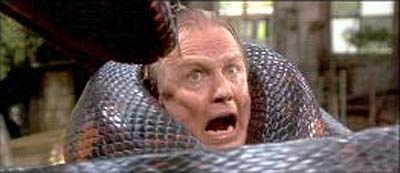 |
| (For example, filming this scene in ANACONDA was morally unambiguous ground, since Jon Voight actually signed and notarized a waver to give his life to the jaws of a giant serpent for the movie. He later found out that they were using an animatronic snake, but in case the thing broke down on set or something and it turned out to be more expensive to repair it than train a real anaconda, his consent was clear. These are the kinds of issues you learn to navigate in human subjects training in the research field) |
All this being said, if your tastes are like mine, I highly recommend BELLFLOWER. I don’t know about you, but I kind of like the tingle in your spine you get from confronting something a little evil. I like the little thrill you get from daring to experience it, if for only a second and from a safe distance, finding something interesting and even poetic in something clearly dark and dangerous (especially if it’s presented well, or in a unique way), then clicking off the TV, putting the Netflix disc back in its sleeve, and walking away. Or figuring out you were just burning Milly’s shit on the beach instead of doing all the things you probably have, at some point, probably fantasized about doing to at least one particularly wicked ex, male or female.
-Shenan
Wednesday, February 29, 2012
Ambrose and ANTICHRIST: Separated by Centuries, Connected by Awesomeness
GUEST POST
Hey Dan’s readers (theatrical aside, re: the last guest post I did for Dan: Shenan: “You should go in and change that part where I said there were spoilers. I don’t really reveal any twists or anything, and I feel like your readers are just going to stop reading it after seeing that in the beginning.” Dan: “My readers? You mean Joe. My readers are Joe.” Shenan: “And Andy!! And I linked to it on Facebook so I bet some random people will click on it...”). So I guess, hey Andy and Joe and random people who click here from Facebook. Guess who it is again (hint: one of the two people in the above conversation, and not Dan). I know, pretty soon Dan’s blog is going to have more of my content on it than his (well, save for during the month of October). And I know, I’m no “Dan P.” as he refers to his internet-self as. But when I was going on and on about all this stuff I’d written on a post-it note and stuck inside a random work notebook that I’d just found, Dan suggested I write another blog post on it. So here I am, writin’ a blog post! It’ll make sense soon, I promise.
Hey Dan’s readers (theatrical aside, re: the last guest post I did for Dan: Shenan: “You should go in and change that part where I said there were spoilers. I don’t really reveal any twists or anything, and I feel like your readers are just going to stop reading it after seeing that in the beginning.” Dan: “My readers? You mean Joe. My readers are Joe.” Shenan: “And Andy!! And I linked to it on Facebook so I bet some random people will click on it...”). So I guess, hey Andy and Joe and random people who click here from Facebook. Guess who it is again (hint: one of the two people in the above conversation, and not Dan). I know, pretty soon Dan’s blog is going to have more of my content on it than his (well, save for during the month of October). And I know, I’m no “Dan P.” as he refers to his internet-self as. But when I was going on and on about all this stuff I’d written on a post-it note and stuck inside a random work notebook that I’d just found, Dan suggested I write another blog post on it. So here I am, writin’ a blog post! It’ll make sense soon, I promise.
Now, when I once admitted going
to see Dark Star Orchestra, a band that recreates exact set-lists from actual
Grateful Dead concerts in each show they play, back in my high school days
(...twice), Dan said to me, “That is possibly the nerdiest thing you’ve ever
confessed to doing.” Well, this blog post might trump that. I think I just did
something nerdier. And it involves these two men:


(Not as sexy as it sounds)
Yes, that would be Lars von
Trier, artsy pteromerhanophic Danish director, and Ambrose Bierce, 19th Century American journalist
and short-story author and bad-ass-mysterious-Mexican-desert-disappearer-into. Awhile ago, I started thinking about
Ambrose Bierce (I mean, who doesn’t on a slow day at work?), and started
getting a weird sense of deja vu. Of course, my natural first instinct was to
think, “Fucking A! I guess that settles it once and for all: I must’ve been ol’
A.B. in a former life!” But then I realized it was because I’d just watched
Lars von Trier’s ANTICHRIST, and many of the same tropes, motifs, and symbols
seemed to be resonating between centuries in the works of these two artists. At
least that means I never had to experience sustaining a serious head wound in
the Battle of Kennesaw Mountain. Or being Danish. (Ba-da tsss! All in good fun,
Danes)
Now, I’m not really sure if this
post is going to reach some overarching conclusion or point by the end of its
exploration, but I thought it’d be fun and maybe a little interesting to
compare some Ambrose Bierce stories and how they may have influenced or been
borrowed from, or just totally coincidentally correlate with, ANTICHRIST. Since
readership is mostly limited to people I know have seen ANTICHRIST, I’m going
to dive right in and avoid describing its plot in detail. But I will describe
some Ambrose Bierce stories along the way.
First off: let’s take the short
story “The Damned Thing” from 1894. This is arguably one of Bierce’s most
famous stories (besides “An Occurrence At Owl Creek Bridge,” which most
everybody probably had to read in middle school or high school), and was made
into a MASTERS OF HORROR episode in 2006 (in kind of a weird interpretation
with a really shitty CGI monster at the end, which essentially negates the
whole point of the short story). I first read it in a tattered used copy of a
circa-1950s compendium of horror-related short stories edited by--wait for
it--Boris Karloff. I remember reading it aloud to my friends in my parents’
basement and being totally entranced by it (yep, if you didn’t think
younger-Shenan was nerdy enough after the DSO concert thing, that’s what else I
did in my free time). “The Damned Thing” starts out in Hugh Morgan’s cabin,
where a whole bunch of townspeople, local farmers, a coroner, and the dead body
of Hugh Morgan have gathered. William Harker, a good friend of Morgan’s, comes
forth to offer insight into how Morgan’s body ended up so mangled and lifeless,
via Morgan’s diary and his own recollections of a hunting trip he took with
Morgan. He tells everyone how when he and Morgan were in the woods hunting,
they encountered something unseen thrashing around in the bushes, which Morgan
referred to as “the damned thing,” apparently familiar with whatever it was.
Moving closer to the wild oats where the thing seemed to be, with guns cocked,
Morgan and Harker see the oats being crushed, with seemingly nothing atop them.
Though he seems to recall no fear, Harker says that the experience left an
unsettling effect on him. As he tells it,
...once in
looking carelessly out of an open window I momentarily mistook a small tree
close at hand for one of a group of larger trees at a little distance away. It
looked the same size as the others, but being more distinctly and sharply
defined in mass and detail seemed out of harmony with them. It was a mere
falsification of the law of aerial perspective, but it startled, almost
terrified me. We so rely upon the orderly operation of familiar natural laws
that any seeming suspension of them is noted as a menace to our safety, as
warning of unthinkable calamity.
Long story short, Morgan fires
his gun at whatever is disturbing the oats, and before he knows it, Harker is
thrown to the ground and hears Morgan screaming in agony somewhere in the
distance. He looks over and sees Morgan’s body being thrashed about from side
to side as if in violent, supernatural convulsions. And by the time he reaches
him, he’s dead. Of course, the coroner doesn’t buy this story, concludes that
Morgan was maimed by a mountain lion, and leaves Harker feeling more than a
little bit invalidated. Similarly, we learn through some final excerpts from
Morgan’s diary, Morgan worried he was insane when he first began to encounter
“the damned thing.” But he eventually concludes that he’s not insane. He
references the actinic rays that the human eye is no able to detect, stating
that the eye’s “range is but a few octaves of the real chromatic
scale,” and similarly, that there are notes that the human ear cannot
detect. He concludes that there exist things in the natural world that humans
cannot perceive, and our own (literal and metaphorical) blindness to these
things terrifies us, instinctually.

Now tell me you’re not thinking
of ANTICHRIST at this point. And not just because I inserted that picture
above. So many of the same themes seen in "The Damned Thing" are echoed in
ANTICHRIST. ANTICHRIST is all about The Woman’s (and eventually The Man’s)
terror at the seemingly innocuous (and ironically named) Eden, because of
something at work that they can’t perceive, that nevertheless has total power
over them. It’s at the root of all anxieties, fear of something in which
neither the feared thing nor the fear itself fit into the heuristic by which we
view the world, and it’s a powerful button to press in the viewer/reader.
Additionally, both the movie and
the story play on the fact that what seems inanimate actually has a
consciousness that we can’t perceive the whole of. Like an evil Gaia Theory
gone rogue, ANTICHRIST posits that a place can be evil, that “nature is Satan’s
church,” in a much more sinister turn of Ambrose Bierce’s words:
I have
observed a flock of blackbirds occupying an entire tree-top — the tops of several
trees — and all in full song. Suddenly — in a moment — at absolutely the same
instant — all spring into the air and fly away. How? They could not all see one
another — whole tree-tops intervened. At no point could a leader have been
visible to all. There must have been a signal of warning or command, high and
shrill above the din, but by me unheard...It is known to seamen that a school
of whales basking or sporting on the surface of the ocean, miles apart, with
the convexity of the earth between, will sometimes dive at the same instant —
all gone out of sight in a moment. The signal has been sounded — too grave for
the ear of the sailor at the masthead and his comrades on the deck — who
nevertheless feel its vibrations in the ship as the stones of a cathedral are
stirred by the bass of the organ.
Flocks of birds lifting off at
once in silent Vs, whales diving simultaneously miles apart: these groups of
animals all move with one consciousness, as limbs of one being, form something
greater than sum of its parts when its parts are all we can perceive in our
limited grasp. And if we can only grasp its parts, how can we begin to
understand its full nature? Its goodness, or its evil? And by extension, our
full nature, our goodness or evil, what we’re connected to and affected by in
ways we might not see? We can’t, and that’s what makes it so damn terrifying.

And, just to show you how
horrifically the MASTERS OF HORROR episode mangled the entire concept of the
story just as the damned thing mangled Hugh Morgan’s body, here is the image
they chose to reveal of the damned thing:

It’s a poor screen-cap, but
really? Really? You’re going to ruin the whole point by showing it at all, and
that’s what you show? A monster made of oil blobs?
Moving on, I also noticed eerily
similar imagery to that of ANTICHRIST in Bierce’s 1891 story “Chickamauga.”
This is a haunting story that no doubt drew on Bierce’s experiences as a Civil
War soldier. The gist of “Chickamauga” is this: a little boy is playing by
himself in the woods, wandering about pretending he’s a general commanding an
army. He falls asleep in the woods, and when he awakens, there are men all
around him. Some are walking, some are crawling, some are lying on the ground
bloodied and motionless. I think I’m going to let Ambrose Bierce’s startlingly
evocative words do the describing of this:
Singly, in
pairs and in little groups, they came on through the gloom, some halting now
and again while others crept slowly past them, then resuming their movement.
They came by dozens and by hundreds; as far on either hand as one could see in
the deepening gloom they extended and the black wood behind them appeared to be
inexhaustible. The very ground seemed in motion toward the creek. Occasionally
one who had paused did not again go on, but lay motionless. He was dead. Some,
pausing, made strange gestures with their hands, erected their arms and lowered
them again, clasped their heads; spread their palms upward, as men are
sometimes seen to do in public prayer...
...Something
in this—something too, perhaps, in their grotesque attitudes and
movements—reminded him of the painted clown whom he had seen last summer in the
circus, and he laughed as he watched them. But on and ever on they crept, these
maimed and bleeding men, as heedless as he of the dramatic contrast between his
laughter and their own ghastly gravity. To him it was a merry spectacle. He had
seen his father’s negroes creep upon their hands and knees for his
amusement—had ridden them so, “making believe” they were his horses. He now
approached one of these crawling figures from behind and with an agile movement
mounted it astride. The man sank upon his breast, recovered, flung the small
boy fiercely to the ground as an unbroken colt might have done, then turned upon
him a face that lacked a lower jaw—from the upper teeth to the throat was a
great red gap fringed with hanging shreds of flesh and splinters of bone. The
unnatural prominence of nose, the absence of chin, the fierce eyes, gave this
man the appearance of a great bird of prey crimsoned in throat and breast by
the blood of its quarry. The man rose to his knees, the child to his feet. The
man shook his fist at the child; the child, terrified at last, ran to a tree
near by, got upon the farther side of it and took a more serious view of the
situation. And so the clumsy multitude dragged itself slowly and painfully
along in hideous pantomime—moved forward down the slope like a swarm of great
black beetles, with never a sound of going—in silence profound, absolute.
Holy fucking shit. Let’s all just
take a moment to just sit with those words before we move on. Maybe re-read
them and let them knock the wind out of you again? I hope I write something
1/10th that good someday.
So then, of course you presume
now that the “Chickamauga” of the title is the Battle of Chickamauga, from
which these men are staggering away. The little boy still does not fully grasp
the horror of what has happened to these men, or the horror of war itself, and
continues on playing in his fantasy version of war, joyfully walking home again
through the woods leading all these “soldiers” at his precocious little
command. And then he emerges from the forest to see his home on fire and his
mother lying on the ground dead, and the story ends without needing to tell us
in so many words that he grasps the reality of war and death for the first
time. “Then
he stood motionless, with quivering lips, looking down upon the wreck.”
This one doesn’t evoke themes as
much (though you could make the argument that the boy’s lack of
perception/perspective on the horrors around him mirrors The Man’s initial lack
of and eventually gaining of understanding of the evil of Eden), but it’s final
image is chillingly similar to the final image of ANTICHRIST. This one:


“Chickamauga” actually what I instantly thought of when I
saw the ending of ANTICHRIST, the final scene where Willem Dafoe marches
through the forest out of Eden with an “army” of ghostly women. Did von Trier
ever read this slightly obscure story from the American Civil War literature
canon? I’m guessing the answer’s probably “no,” but perhaps this image is so
haunting (and perhaps so universal to war/death/evil/groups of people walking
in general) that it’s nestled itself into the consciousnesses of people
worldwide.
Finally, we have “The Boarded Window” (1891). This story is
about a man named Murlock whose wife dies and, after he prepares her for burial
in his remote cabin, he hears the cry of a child in the distance. He is puzzled
and slightly disturbed, but falls asleep, only to awaken to a mysterious
presence in his house. All of a sudden, he feels/hears a body being slammed
against the table where his wife had been lain, and reaches up to feel that no
body is there. He thinks that he’s going insane with fear--as Bierce writes, “There
is a point at which fear may turn to insanity; and insanity incites to action.
With no definite plan and acting like a madman, Murlock ran quickly to the
wall. He seized his loaded rifle and without aim fired it.”
The blast from the gun reveals that it’s a panther, dragging away the
body of his wife. He passes out, and awakens to find the body of his wife on
the floor, all disheveled from the panther. With...the ear of the panther in
her mouth. What?
OK, what does this have to do
with ANTICHRIST, you might ask? I’ll admit, the connection is probably a minor
one. But it stood out to me nonetheless. “The Boarded Window” plays with how
our emotions and perceptions can dictate our reality and our nature. Murlock,
never having experienced deep sadness before and finding himself unable or
unsure of how to feel or act in the face of great sadness, does not cry for his
wife. But that doesn’t mean he doesn’t experience her loss; it just doesn’t
manifest itself in the normal emotional channels, translated into the normal
actions carried out in response to those emotions. Bierce writes:
Murlock had no
experience in deep sadness. His heart could not contain it all. His imagination
could not understand it. He did not know he was so hard struck. That knowledge
would come later and never leave.
Deep
sadness is an artist of powers that affects people in different ways. To one it
comes like the stroke of an arrow, shocking all the emotions to a sharper life.
To another, it comes as the blow of a crushing strike. We may believe Murlock
to have been affected that way.
This is a man
clearly transformed by grief he doesn’t know how to experience or deal with,
whose reality and sanity is thus transformed by it too. Or is it only that?
Does his grief perhaps have the power to transform objective reality as well?
How could his wife have ended up with the panther’s ear clenched beneath her
teeth if a) the panther wasn’t real, and b) she was dead.
Grief, anxiety,
and the ways in which our emotions can both alter our subjective perceptions and
objective realities are also themes explored by ANTICHRIST.

von Trier
explores in this movie how one woman could be so wracked with
guilt and anxiety that she begins to question the structure of her own reality
and her own nature, maybe internalizing the kinds of messages she explored in
her graduate studies. She begins to question the issues of inherent guilt
over/evil in being a woman, when a woman's defining feature of being a woman (her
sexuality) causes something "evil" to happen (as it did when her son
fell to his death while she was having sex with her husband). It also takes
anxiety and asks the question: if our fears and sense of evil are really
constructions of our mind, then doesn't that mean there is, inherently,
something evil in ourselves? And doesn't that make our nature evil, if even a
part of it is evil? If you believe yourself to be evil, and internalize
that message, who or what is to say you’re not? What stops you from acting on
it? What stops the world from being evil if that’s how you experience it? Who’s
to say it’s not?

And we’ll end on
a picture of Charlotte Gainsbourg looking like she’s having a lot of fun
playing evil. That’s it! I hope I’ve inspired someone to go out and read some
Ambrose Bierce today. Or re-watch some ANTICHRIST. Or both. We now return to
your regularly scheduled blog programming...
Friday, February 17, 2012
Quick Thoughts: Outrage

See, it only seems like a typical, slow burn Kitano gangster film for the first 20 minutes or so, before it completely flies of the rail and stays that way for the next 90. It's a story about two waring Yakuza families, and how one relatively minor incident leads to a violent reprisal, which leads to another violent reprisal.... which leads to another, then another, then another, and then some more, then maybe a quick breather for dialogue, then another reprisal, then another, and another, and so on until everyone is pretty much dead. Once it gets rolling, pretty much every other scene is a savage beatdown or a violent murder. The cast list is basically just a long line of people who get a few lines of dialogue before getting killed. There is little character development, and absolutely no one the audience could possible sympathize with.
What I admired about Outrage, besides Kitano's typically impeccable visual style and deadpan dark humor, was how, despite the movie is almost wall-to-wall violence, it becomes something of an anti-narrative. I've seen plenty of movies about the never-ending cycle of violence, but few quite like this. The whole movie jogs in place, until it arbitrarily ends. Most gangster movies, even if they don't overtly mean to, tend to romanticize or mythologize the characters; Outrage, despite being highly stylized, never feels for a moment like it's celebrating or enjoying its characters. The violence is so pointless and so frequent that, even if entertaining in a way, it still can't help but make the characters all look like dumb, worthless assholes for participating. It never exactly becomes desensitizing (Kitano is way too good at staging dramatic violence for that), but there's something existentially hollow about it all nonetheless. There's an emotional and narrative void at the center of Outrage that I think makes a potent statement about the nature of violence. Doesn't seem like this one was well received, but I thought it was one of Kitano's best.
Friday, February 10, 2012
Quick Thoughts On Ti West's The Innkeepers

I'll cut to the chase: West's new film The Innkeepers is not that good. As excited as I was for it, I think I knew it wasn't, like, going to reinvent the horror cinema from scratch and bring us into a new era horror film-making, freed from convention and limitations, where it would remain heavily influential for years to come. The Innkeepers doesn't build nearly as much tension as HotD does, isn't quite as atmospheric, maybe gets a little more bogged down in exposition than I would have preferred. But it's still a pretty wonderful and entertaining horror film, and I wanted to briefly express my admiration.
West has a keen understanding that the best parts of horror movies aren't the "scary" parts, but the build-up to and anticipation of the scary parts. HotD was made up almost entirely of build-up and anticipation, to a degree that some people find too slow. Innkeepers one-ups it by mainly focusing on the build-up to the build-ups; it's a horror movie more about cultivating a "hang out" kinda vibe than it is about ghosts and scares.
It tells the story of the only two remaining employees (Sara Paxton and Pat Healy) of an old, supposedly haunted hotel, working during the hotel's last weekend. The hotel is practically empty, so the two decide to see if they can record any proof that ghosts inhabit the hotel before it closes for good. There's plenty of scenes of Paxton slowly walking down hallways to investigate strange noises and all that jazz, but I'd venture to guess even more time is spent on the two employees sitting around, bullshitting, getting drunk and generally trying to pass time. It's a horror film about boredom and the ways people try to kill time while working a tedious job, and mostly it invites the audience to sit back and enjoy watching its protagonists goof off. And as it turns out, this approach makes Paxton and Healy some of the most likable, sympathetic protagonists you're likely to ever see in a horror film. When shit finally does go down, you care about what happens to these people.
Excepting maybe the conclusion, I don't think West's film builds much suspense or excitement, but due to the frequent humor (Paxton trying to throw out a garbage bag she can barely lift was some of the most entertaining physical comedy I've seen in a long while) and West's gift for directing (and mis-directing) the audience's attention, it's greatly entertaining and never less than highly watchable. With a small cast and a limited location, West really makes a nicely textured film which, like HotD, has a nice air of mystery too it without actually having much of a mystery at its center. I particularly like the subplot about the old man who comes to stay at the hotel; his arrival seems to suggest something sinister, but the truth turns out to be more sad and poignant.
I've frequently gone on record complaining about the majority of haunted house-type movies. Not only because I don't believe in ghosts (I don't believe in zombies either, but I love zombie movies), but because most filmmakers use them as an excuse to go hog wild with endless "boo!" scares and arbitrary special effects nonsense. West mostly avoids that and, in fact, mostly plays it SEMI-SPOILERS ambiguous as to whether or not the hotel is actually haunted at all, right up to the ending.
I read an interview with West recently where he indicated he might be a little tired of making horror movies, and wants to move on to something else for his next film. I think he's got the goods, so I'll be excited to see whatever he does next. But although I certainly can't fault the dude for wanting to expand his horizons, part of me is a little bummed that my beloved genre might be losing one of its best young talents.
Sunday, February 5, 2012
The Best New Movies I Saw in 2011
I don't know what to feel about 2011. It was the best year of my life. It was also the worst year of my life. It was probably the most important year of my life so far, and it was absolutely by far the strangest. Most of my life before this year was on a fairly even keel, but 2011 was a year of violent extremes for me personally, often experienced simultaneously, which I hadn't even thought possible. So it's fair to say I have a lot of ambivalence about my year.
What I'm not ambivalent about when it comes to 2011, however, is the movies. I saw so many new movies I loved last year I can scarcely believe it, and there are still so many potentially awesome movies I haven't even gotten around to seeing yet (like The Artist, The Adventures of Tin Tin, Hugo, and Le Havre, just to name a few). Below are 19 movies from 2011 that I cherished deeply, listed alphabetically so as to avoid needless ranking. Which isn't to say I loved all films equally, just that there's no reason to compare them to each other.
Bellflower
Probably the film on this list I'm most conflicted about (very appropriate, considering my year), Bellflower is this year's scrappy little indie film that could. An offbeat tale of a young man who spends his free time preparing for a Road Warrior-esque apocalypse, only to find himself facing more of personal/emotional apocalypse instead, it's a strange and not always satisfying ride through the macho fantasies and emotional immaturity of young men. It's a film with home made flamethrowers and souped-up cars designed for battle, with the threat of violence constantly coiled under the surface, yet it never turns into the exploitation movie you might be expecting. It does eventually climax with some serious violence, but not in an action movie sense. Overall, it's more of a talky character study; granted, the only talky character study I've ever sense that can cite Mad Max as a serious stylistic influence. (I'm sensitive to criticisms that the final act of the film seems like something of a misogynistic fantasy, but after long deliberation I've come to believe that the movie is more commenting on these sorts of attitudes rather than embracing them).
Yet the film is so boldly stylish (not just in its washed out color palette and dirty lenses and blurry shots, but in its dreamy atmosphere and highly subjective story), so perceptive in places, and so unique that I couldn't help but kind of love it. Writer/Director Evan Glodell has crafted a weird, DIY mini-masterpiece that's as ingeniously cobbled together as his characters' handcrafted inventions. And although I might be giving the film a few extra points for its homemade charm, I think it still succeeds as a striking personal and aesthetic statement.
Cave of Forgotten Dreams
Werner Herzog's film about the world's oldest known cave paintings works pretty well as an entertaining, informative, often even quite funny Discovery Channel-esque documentary. But of course this is Herzog we're talking about, so it's also a deeply philosophical look into the nature of time, art, evolution and the age old question of what makes us human. Armed with beautiful visuals and a haunting soundtrack, Herzog takes what could have been fodder for something much more straightforward, and instead uses it as yet another opportunity to stare into the abyss.
A lot of folks praised Cave's lovely use of 3D for helping show the curvature and dimension of the cave drawings better than 2D could. I'm not really convinced that's true (2D creates the illusion of depth just fine). Personally, I loved it because (to my eyes) 3D looks less real, and something about that added unreality adds to the film's ambitious, philosophical themes and recondite tone.
Certified Copy
I've slowly but surely been watching whatever of Iranian filmmaker Abbas Kiarostami's films I've been able to get my hands on over the last two years or so. Certified Copy, I believe his first film not set in Iran (it's set in Tuscany, and the dialogue is mostly in French and English) and one of his only films to feature professional actors, is also one of his best. It's a charming yet beguiling movie about a man and a woman who, over the course of a day spent together, seem to morph from strangers into a couple that have been together many years. What's going on? Are they strangers pretending to be a couple, an old couple pretending to be strangers, or what?
The answer, of course, is that there is no answer; part of the pleasure of Certified Copy is the way it asks you to hold two contradictory thoughts in your mind at the same time. It's not a mystery meant to be solved, but rather a film that embraces ambiguity as a way of exploring ideas about art, about relationships, and about authenticity and originality.
This looks to be the most international attention a Kiarostami film has ever received, because it stars an honest to goodness movie star (Juliette Binoche), and also because western audiences are, sadly, probably much less likely to watch films about Iranians. If you ever check this one out, enjoy it, and want to see more, then I heartily recommend starting with Kiarostami's Close Up, The Wind Will Carry Us, or Where is the Friend's Home? Shirin is also great but probably not for beginners.
Cold Weather
A movie I knew nothing about, in fact had never even heard of until right before I watched it on Netflix a few weeks ago, Cold Weather turned out to be a wonderfully unexpected surprise. Although it eventually meanders its way, reluctantly, into a satisfying and even suspenseful mystery, it's mostly a laid back, human comedy about a likable slacker and his circle of friends. It's a crime/detective film in some senses, but mostly it's just about the textures of these people's lives as they (often aimlessly) amble about, drinking too much, bullshitting and finding ways to kill time. The kind of film where two characters sit in a parked car on a stakeout, but the scene is really more about their funny, digressive and true-to-life conversations they have while waiting, moreso than it is about what they are staking out. The high point of the film might be a hilarious detour where the main character goes looking for a Sherlock Holmes pipe to see if it will help his detective skills; a bizarre, delightful digression that kind of reminded me of that amazing sequence at the beginning of Robert Altman's The Long Goodbye where Elliott Gould's Phillip Marlowe goes shopping for cat food.
Contagion
Contagion, which aims to tell a "realistic" account of how the world might react to a deadly, fast spreading virus, has some interesting commentary about the nature of communication and the media in today's digital world, but I mostly admired the film for its exciting, incredibly streamlined and efficient storytelling. It juggles an intimidating number of major characters and subplots with utter confidence and clarity in a relatively brief hour and forty-five minutes. Yes, it helps that Soderbergh casts recognizable actors in nearly every notable role, but there's also a ruthless economy to the storytelling that pares everything down to the essentials. I'm willing to bet none of the major characters gets more than 15 minutes of screen time (how could they, with so much going on?), yet each story makes an impact, the characters come across as well defined, the stakes feel real, genuine suspense builds throughout, and I even found myself a little touched at the resolution of one of the stories. No mean feat, this.
Drive
I'm not going to bother trying to pick a favorite film this year, but Drive might have been the film that most appealed to me stylistically. (Although Le Quattro Volte gives it a run for its money). The arty crime-thriller happens to be one of my most beloved subgenres in all cinema, and with Drive, director Nicholas Winding Refn firmly establishes himself a master of the form, putting himself in the good company of folks like Jean Pierre Melville, Jules Dassin and William Friedkin. Although his film is filled with memorable characters and quirky twists on the crime movie formula, Winding Refn knows that a real cinephile loves crime films not so much because of the specifics of the story, but because of the style. Here, he pares down the dialogue, lets the audience's familiarity with the tropes of the genre do much of the heavy lifting in the storytelling department, and instead amps up and luxuriates in the attitude and the atmosphere: the Tangerine Dream-esque synthy-heavy soundtrack, Ryan Gosling's ridiculous scorpion jacket, the gestures and posture and poise of its underworld characters, and of tantalizing build ups to bright red explosions of graphic violence.
I don't mean to imply that the film is simplistic or lacking in any nuance, but there's a sense in which the characters are more icons than people, meant to represent striped down yet idealized versions of stock characters: the silent, stoic hero; the mentor figure; the damsel in distress; the heartless gangster. It's not as self-consciously iconic as Walter Hill's The Driver (note: I am not knocking that awesome film), although it was likely an influence, and it gives these characters and its shop worn plot something of a fresh, quirky spin. It succeeds, as the best of these films do, both as an entertaining crime film, and as an artsy, stylized commentary on the genre.
The Future
It had been a good six years since Miranda July's previous feature, the wonderful Me and You and Everyone We Know. Let's hope it doesn't take her that long to get around to making another film. Somewhat toning down the indie quirkfest trappings of her debut (although, this is plenty quirky, so people who can't take a little tweeness should stay away), The Future is a much darker and ambitious film. Narrated by a cat (!), it tells the story of a couple who decide to shake things up, quit their jobs and try to follow the dreams they've been neglecting for years... only to discover things about their lives and their relationship that maybe they would have been happier not knowing. Starting from a place more grounded in reality, July allows the film to become more strange and experimental as it goes along, involving some bold narrative devices, striking visuals, surrealism and some magic realism. It's an oddball, often funny (funny strange and funny ha-ha) and strangely haunting film about the difficulty of maintaining a mature relationships when you're an overgrown adolescent that struck a wider range of notes than I expected.
Higher Ground
I saw Higher Ground, the directorial debut of actress Vera Farmiga, just in the nick of time to make this list. It's a lovely, mostly pitch perfect story about the religious journey of a woman, how her desire to believe first leads her to a close-knit religious community, and then eventually to her doubts and disillusionment. It's a thoughtful, open-minded film about the nature of faith that never really chooses sides or tries to make a statement. Instead, it views everyone with empathy and tries to chart the heroine's journey honestly and straightforwardly. If the film maybe overstates it themes a little too obviously in the final scenes, it should still be credited for avoiding a tidy resolution, instead literally leaving the heroine standing halfway in and halfway out the door of her congregation.
Kung Fu Panda 2
Not as funny as the original, but even more beautifully animated, and with some of the most eye-popping action scenes I've seen in years, Kung Fu Panda 2 is a real treat for those of us who realize that, with the piss poor state of modern action cinema in America, that animation has become to home to most of our best action flicks. Goofy and lightweight though it may be, I'd hold this up to the best of Pixar's work. It may be less thematically ambitious or emotionally resonant, but it packs a aesthetic punch, with it's almost overwhelmingly ornate visuals and its breathless sense of kinetic energy. Not the best film I saw this year, but maybe the most exciting to watch.

Le Quattro Volte
Read my semi-coherent thoughts on this incredible film here.
Mission: Impossible - Ghost Protocol
My faith in Hollywood blockbusters has been restored. If I recall correctly, Kingdom of the Crystal Skull was the last mega-budget, live-action, action/adventure movie to really use its scope and scale to create some bonafide, edge-of-your-seat, awe-inspiring movie magic. As noted above, animation has become the best medium for American action scenes in the past decade, and Brad Bird has given us some of the best in his films The Iron Giant, The Incredibles, and Ratatouille. Now, with his first live action feature, he may have topped himself. Mission Impossible - Ghost Protocol is a real treat: an almost nonstop cavalcade of inventive action sequences & clever visual gags. Far and away the best of the series (the second best, Brian De Palma's original, doesn't even come close)
Rango
The strangest "kids" movie in a long damn wild, I don't even know how to classify Rango. It's a trippy animated western/action "kids" film slash fish out of water comedy with a truly oddball lead character. I put "kids" in quotes because this is one of those family films that seems aimed more at the parents than their little tots. Not because of any inappropriate humor or anything; just because its entire sensibility seems like it would go right over the kiddies' heads. Either way, the film is hilarious, visually beautiful and has some great action scenes. And I can't do it justice, but the scene where a character with an arrow shot through one eye complains about the conjunctivitis in his other eye might have been my favorite joke in any movie I saw last year.
Rubber
You can read my even less coherent thoughts on this little oddity here.
The Skin I Live In
Pedro Almodovar specializes in visually elegant, sexually adventurous, genre-bending soap operas with fractured timelines, based around unfathomably complex plots and crazy plot twists. The Skin I Live In, perhaps my favorite film of his I've seen, is sort of life Almodovar's take on Eyes Without a Face, and it does something I never really expected from one of his films: it presents sexuality that is profoundly transgressive and disturbing. Usually, the anything-goes sexual mores of his characters is celebrated, but here he gives us a film about a mad scientist who experiments on and sleeps with a beautiful woman that he keeps in captivity, and it only gets stranger from there. Dismissed by some critics for being shallow, I'd agree that The Skin I Live In is certainly a film about surfaces, but it slowly reveals deep, dark secrets that are more thoughtful than it was given credit for. Not a horror film, per se, it tells a story that gets under your skin (to make a lousy pun) in the same manner than the best horror films do.
Take Shelter
Jeff Nichols' debut film Shotgun Stories is a fantastic film, but it felt almost a little too much like one of producer David Gordon Green's films. It came off like a talented filmmaker was playing in someone else's sandbox. With Take Shelter, Nichols moves away from Green's quirky Southern Gothic style and begins to more firmly assert his individuality as a filmmaker. An almost unbearably intense drama about one man's mental unraveling as he becomes convinced that an apocalyptic storm is coming and that he must protect his family, it features yet another in a long line of great Michael Shannon performances. I have serious misgivings about Take Shelter's final scene, which seems to spit in the face of the rest of the film, but that's ultimately a minor quibble to make about such a powerful, strongly crafted and emotionally harrowing film.
The Tree of Life
Out-ambition-ing even the insanely ambitious Le Quattro Volte, Terrence Mallick's The Tree of Life tells the story of a man reflecting on his childhood in the 1950's, shown in the context of no less than the entire creation of the earth. I've admired Mallick's other films, but I think this time he finally found the perfect match in terms of story. He's never really been much of a storyteller, in my estimation, because he seems a lot more interested in dazzling visuals and the internal struggles of his characters than he ever did with what was happening in the "plot" of his films. By framing this story through one man looking back on his life, the fractured and de-empahisized storyline seems more like a representation of memory than it does any sort of storytelling flaws.
The ultimate message of the film seems to be a religious one, which as an atheist doesn't much interest me (surprisingly, the film's finale, which seems to depict something like heaven or transcendence, is actually the most dull, least visually stunning part of the film), but I certainly don't begrudge an artist for wanting to ask big questions or explore the nature of their god. And the religious angle actually makes Mallick's extensive use of voice-over narration, which could come off as overbearing and too on-the-nose in some of his other films, fit in perfectly: it sounds more like the characters are praying than it does the director spelling out his themes too pointedly. Still, I think the reason the film achieves greatness has little to do with its religious aspects and more to do with its trippy, mindblowing visuals, its evocative depiction of childhood, and just the stunning hugeness of the whole endeavor. It's a film unafraid to aim for greatness, one that really wants to take the audience's breath away, and I for one was frequently awed.
Uncle Boonmee Who Can Recall His Past Lives
If you asked me to make a list of my 10 favorite films of the 00's, Apichatpong Weerasethakul's Syndromes and a Century would likely make the cut. All of his films are special and remarkable in some way, but Syndromes is in a class of its own, and it seems to me unrealistic to expect Joe (as he says we can call him) would ever be able to top it. It's no surprise that Uncle Boonmee Who Can Recall His Past Lives doesn't clear that bar, but that doesn't mean it's not a great film in its own right.
I didn't know what to make of Uncle Boonmee the first time I saw it, but that is kind of true of all of Joe's films. I think the key to his films is to let go and stop searching for literal meaning; you may or may not find some (and each viewing seems to reveal more and more layers), but it's best to just try to absorb the unique atmosphere of serene bizarreness (and maybe a little deadpan humor). If I told you this film involved ghosts, doppelgangers, hairy gorilla men with glowing red eyes, and women having sex with talking fish, you'd probably imagine a film that outdoes Jodorowsky for off-the-wall weirdness. And yet there's such a peacefulness and stillness and ponderousness to Joe's film that it never comes off as a provocation, but more like a funny dream you could have while you're half asleep in bed. Joe says his film is about movies, that it's a journey through different genres and styles, but I doubt most audiences would ever independently come to that conclusion; it doesn't feel like any other film you've ever seen, unless you've seen his others.
Weekend
It may be a little reductive, but the best way to describe Weekend is probably to call it a gay version of Before Sunrise: two young men meet at a night club, sleep together, and then spend the weekend getting to know each other before one of them leaves the country for school. And like Linklater's film, Weekend is simple yet profound, laid back yet moving, romantic but with a little darkness. It hits on some broader themes about modern life for gays (being in vs. out, gay rights, coming out to your family, etc.), but mostly it's just about the bond that forms and the feelings that develop between these two interesting guys, even if one of them doesn't want to admit it. It also features some very frank, realistic and (relatively, given what is normally shown of gays in film) graphic sex scenes, which I think is a refreshing change of pace. Director Andrew Haigh strikes just the right tone and sustains it through the film, and with the help of a great cast, pulls the audience in this story despite the low stakes. Most of the other films on my list have been big, crazy, ambitious epics, but Weekend is the perfect example of a great little film; just because it's modest doesn't mean it's not fantastic.
The Woman
Also seen just in time to make the list, The Woman is Lucky McKee's long-awaited return, and a triumphant return it indeed is. The seemingly wholesome patriarch of an All-American family discovers a woman, raised as an animal, living in the woods. So naturally, he abducts her, locks her up in the cellar, and tells his family it's their job to "civilize" the woman. The whole idea of civilization and wholesomeness just being a thin veneer over brutality and monsterousness is hardly a new idea, but McKee and co-writer Jack Ketchum give it a bizarre and disturbing tweak. Although they named the film The Woman, a better name might have been The Family, as the film more details the increasingly unsettling dynamics between this, um, unique family unit. McKee peels back more and more layers of strangeness, beginning with small little cracks in the foundation, introducing increasingly unnerving and alarming moments, and finally building to a shit-hits-the-fan ending of admirably sustained intensity. You may see the ending coming, but that doesn't make it any less of a gobstopper. The best horror movie I saw from 2011.
So those were the "great" movies I saw, but I'll also give a shout out to a few films that, if they didn't quite go all the way for me, were remarkable in their own special way:
Carnage - Roman Polanski's highly entertaining dark comedy of manners.
Film Socialisme - It's as if Godard threw all of his movies from the last 30 years in a blender, and came up with this confusing but fascinating collage of styles and ideas.
Julia's Eyes - Toning down the surrealism of Morlaes's The Uninvited Guest, this horror flick is more like a Spanish giallo; strange, scary and stylish.
Melancholia - Antichrist's moody teenage sister, which explores depression by presenting it as the apocalypse.
Shame - Gorgeous but chilly tale of sex addiction, with a typically great Michael Fassbender performance.
Terri - Best coming-of-age movie in a long time, sad and funny, and doesn't pull its punches.
13 Assassins - The most normal thing I've seen Miike do, sort of his take on Seven Samurai. The big action packed finale was a cinematic high-point for the year.
Win Win - Maybe not quite as sublime at McCarthy's last two films, but still shares their low key charms and superb character work.
And just to continue to prove my point of how kick ass 2011 was for movies, here are a bunch more I saw that I'd have no trouble strongly recommending:
Bedevllied
Bereavement
Bridesmaids
Cold Fish
Crazy Stupid Love
A Dangerous Method
Don't Be Afraid of the Dark
Dream Home
50/50
Fast Five
Final Destination 5
Friends With Benefits
Fright Night
A Horrible Way to Die
Hostel: Part 3
I Saw the Devil
Kaboom
Martha Marcy May Marlene
Meek's Cutoff
Moneyball
Paul
Red State
Rise of the Planet of the Apes
Road to Nowhere
Source Code
Super
Transformers: Dark of the Moon
X-Men: First Class
What I'm not ambivalent about when it comes to 2011, however, is the movies. I saw so many new movies I loved last year I can scarcely believe it, and there are still so many potentially awesome movies I haven't even gotten around to seeing yet (like The Artist, The Adventures of Tin Tin, Hugo, and Le Havre, just to name a few). Below are 19 movies from 2011 that I cherished deeply, listed alphabetically so as to avoid needless ranking. Which isn't to say I loved all films equally, just that there's no reason to compare them to each other.
Bellflower
Probably the film on this list I'm most conflicted about (very appropriate, considering my year), Bellflower is this year's scrappy little indie film that could. An offbeat tale of a young man who spends his free time preparing for a Road Warrior-esque apocalypse, only to find himself facing more of personal/emotional apocalypse instead, it's a strange and not always satisfying ride through the macho fantasies and emotional immaturity of young men. It's a film with home made flamethrowers and souped-up cars designed for battle, with the threat of violence constantly coiled under the surface, yet it never turns into the exploitation movie you might be expecting. It does eventually climax with some serious violence, but not in an action movie sense. Overall, it's more of a talky character study; granted, the only talky character study I've ever sense that can cite Mad Max as a serious stylistic influence. (I'm sensitive to criticisms that the final act of the film seems like something of a misogynistic fantasy, but after long deliberation I've come to believe that the movie is more commenting on these sorts of attitudes rather than embracing them).
Yet the film is so boldly stylish (not just in its washed out color palette and dirty lenses and blurry shots, but in its dreamy atmosphere and highly subjective story), so perceptive in places, and so unique that I couldn't help but kind of love it. Writer/Director Evan Glodell has crafted a weird, DIY mini-masterpiece that's as ingeniously cobbled together as his characters' handcrafted inventions. And although I might be giving the film a few extra points for its homemade charm, I think it still succeeds as a striking personal and aesthetic statement.
Cave of Forgotten Dreams
Werner Herzog's film about the world's oldest known cave paintings works pretty well as an entertaining, informative, often even quite funny Discovery Channel-esque documentary. But of course this is Herzog we're talking about, so it's also a deeply philosophical look into the nature of time, art, evolution and the age old question of what makes us human. Armed with beautiful visuals and a haunting soundtrack, Herzog takes what could have been fodder for something much more straightforward, and instead uses it as yet another opportunity to stare into the abyss.
A lot of folks praised Cave's lovely use of 3D for helping show the curvature and dimension of the cave drawings better than 2D could. I'm not really convinced that's true (2D creates the illusion of depth just fine). Personally, I loved it because (to my eyes) 3D looks less real, and something about that added unreality adds to the film's ambitious, philosophical themes and recondite tone.
Certified Copy
I've slowly but surely been watching whatever of Iranian filmmaker Abbas Kiarostami's films I've been able to get my hands on over the last two years or so. Certified Copy, I believe his first film not set in Iran (it's set in Tuscany, and the dialogue is mostly in French and English) and one of his only films to feature professional actors, is also one of his best. It's a charming yet beguiling movie about a man and a woman who, over the course of a day spent together, seem to morph from strangers into a couple that have been together many years. What's going on? Are they strangers pretending to be a couple, an old couple pretending to be strangers, or what?
The answer, of course, is that there is no answer; part of the pleasure of Certified Copy is the way it asks you to hold two contradictory thoughts in your mind at the same time. It's not a mystery meant to be solved, but rather a film that embraces ambiguity as a way of exploring ideas about art, about relationships, and about authenticity and originality.
This looks to be the most international attention a Kiarostami film has ever received, because it stars an honest to goodness movie star (Juliette Binoche), and also because western audiences are, sadly, probably much less likely to watch films about Iranians. If you ever check this one out, enjoy it, and want to see more, then I heartily recommend starting with Kiarostami's Close Up, The Wind Will Carry Us, or Where is the Friend's Home? Shirin is also great but probably not for beginners.
Cold Weather
A movie I knew nothing about, in fact had never even heard of until right before I watched it on Netflix a few weeks ago, Cold Weather turned out to be a wonderfully unexpected surprise. Although it eventually meanders its way, reluctantly, into a satisfying and even suspenseful mystery, it's mostly a laid back, human comedy about a likable slacker and his circle of friends. It's a crime/detective film in some senses, but mostly it's just about the textures of these people's lives as they (often aimlessly) amble about, drinking too much, bullshitting and finding ways to kill time. The kind of film where two characters sit in a parked car on a stakeout, but the scene is really more about their funny, digressive and true-to-life conversations they have while waiting, moreso than it is about what they are staking out. The high point of the film might be a hilarious detour where the main character goes looking for a Sherlock Holmes pipe to see if it will help his detective skills; a bizarre, delightful digression that kind of reminded me of that amazing sequence at the beginning of Robert Altman's The Long Goodbye where Elliott Gould's Phillip Marlowe goes shopping for cat food.
Contagion
Contagion, which aims to tell a "realistic" account of how the world might react to a deadly, fast spreading virus, has some interesting commentary about the nature of communication and the media in today's digital world, but I mostly admired the film for its exciting, incredibly streamlined and efficient storytelling. It juggles an intimidating number of major characters and subplots with utter confidence and clarity in a relatively brief hour and forty-five minutes. Yes, it helps that Soderbergh casts recognizable actors in nearly every notable role, but there's also a ruthless economy to the storytelling that pares everything down to the essentials. I'm willing to bet none of the major characters gets more than 15 minutes of screen time (how could they, with so much going on?), yet each story makes an impact, the characters come across as well defined, the stakes feel real, genuine suspense builds throughout, and I even found myself a little touched at the resolution of one of the stories. No mean feat, this.
Drive
I'm not going to bother trying to pick a favorite film this year, but Drive might have been the film that most appealed to me stylistically. (Although Le Quattro Volte gives it a run for its money). The arty crime-thriller happens to be one of my most beloved subgenres in all cinema, and with Drive, director Nicholas Winding Refn firmly establishes himself a master of the form, putting himself in the good company of folks like Jean Pierre Melville, Jules Dassin and William Friedkin. Although his film is filled with memorable characters and quirky twists on the crime movie formula, Winding Refn knows that a real cinephile loves crime films not so much because of the specifics of the story, but because of the style. Here, he pares down the dialogue, lets the audience's familiarity with the tropes of the genre do much of the heavy lifting in the storytelling department, and instead amps up and luxuriates in the attitude and the atmosphere: the Tangerine Dream-esque synthy-heavy soundtrack, Ryan Gosling's ridiculous scorpion jacket, the gestures and posture and poise of its underworld characters, and of tantalizing build ups to bright red explosions of graphic violence.
I don't mean to imply that the film is simplistic or lacking in any nuance, but there's a sense in which the characters are more icons than people, meant to represent striped down yet idealized versions of stock characters: the silent, stoic hero; the mentor figure; the damsel in distress; the heartless gangster. It's not as self-consciously iconic as Walter Hill's The Driver (note: I am not knocking that awesome film), although it was likely an influence, and it gives these characters and its shop worn plot something of a fresh, quirky spin. It succeeds, as the best of these films do, both as an entertaining crime film, and as an artsy, stylized commentary on the genre.
The Future
It had been a good six years since Miranda July's previous feature, the wonderful Me and You and Everyone We Know. Let's hope it doesn't take her that long to get around to making another film. Somewhat toning down the indie quirkfest trappings of her debut (although, this is plenty quirky, so people who can't take a little tweeness should stay away), The Future is a much darker and ambitious film. Narrated by a cat (!), it tells the story of a couple who decide to shake things up, quit their jobs and try to follow the dreams they've been neglecting for years... only to discover things about their lives and their relationship that maybe they would have been happier not knowing. Starting from a place more grounded in reality, July allows the film to become more strange and experimental as it goes along, involving some bold narrative devices, striking visuals, surrealism and some magic realism. It's an oddball, often funny (funny strange and funny ha-ha) and strangely haunting film about the difficulty of maintaining a mature relationships when you're an overgrown adolescent that struck a wider range of notes than I expected.
Higher Ground
I saw Higher Ground, the directorial debut of actress Vera Farmiga, just in the nick of time to make this list. It's a lovely, mostly pitch perfect story about the religious journey of a woman, how her desire to believe first leads her to a close-knit religious community, and then eventually to her doubts and disillusionment. It's a thoughtful, open-minded film about the nature of faith that never really chooses sides or tries to make a statement. Instead, it views everyone with empathy and tries to chart the heroine's journey honestly and straightforwardly. If the film maybe overstates it themes a little too obviously in the final scenes, it should still be credited for avoiding a tidy resolution, instead literally leaving the heroine standing halfway in and halfway out the door of her congregation.
Kung Fu Panda 2
Not as funny as the original, but even more beautifully animated, and with some of the most eye-popping action scenes I've seen in years, Kung Fu Panda 2 is a real treat for those of us who realize that, with the piss poor state of modern action cinema in America, that animation has become to home to most of our best action flicks. Goofy and lightweight though it may be, I'd hold this up to the best of Pixar's work. It may be less thematically ambitious or emotionally resonant, but it packs a aesthetic punch, with it's almost overwhelmingly ornate visuals and its breathless sense of kinetic energy. Not the best film I saw this year, but maybe the most exciting to watch.

Le Quattro Volte
Read my semi-coherent thoughts on this incredible film here.
Mission: Impossible - Ghost Protocol
My faith in Hollywood blockbusters has been restored. If I recall correctly, Kingdom of the Crystal Skull was the last mega-budget, live-action, action/adventure movie to really use its scope and scale to create some bonafide, edge-of-your-seat, awe-inspiring movie magic. As noted above, animation has become the best medium for American action scenes in the past decade, and Brad Bird has given us some of the best in his films The Iron Giant, The Incredibles, and Ratatouille. Now, with his first live action feature, he may have topped himself. Mission Impossible - Ghost Protocol is a real treat: an almost nonstop cavalcade of inventive action sequences & clever visual gags. Far and away the best of the series (the second best, Brian De Palma's original, doesn't even come close)
Rango
The strangest "kids" movie in a long damn wild, I don't even know how to classify Rango. It's a trippy animated western/action "kids" film slash fish out of water comedy with a truly oddball lead character. I put "kids" in quotes because this is one of those family films that seems aimed more at the parents than their little tots. Not because of any inappropriate humor or anything; just because its entire sensibility seems like it would go right over the kiddies' heads. Either way, the film is hilarious, visually beautiful and has some great action scenes. And I can't do it justice, but the scene where a character with an arrow shot through one eye complains about the conjunctivitis in his other eye might have been my favorite joke in any movie I saw last year.
Rubber
You can read my even less coherent thoughts on this little oddity here.
The Skin I Live In
Pedro Almodovar specializes in visually elegant, sexually adventurous, genre-bending soap operas with fractured timelines, based around unfathomably complex plots and crazy plot twists. The Skin I Live In, perhaps my favorite film of his I've seen, is sort of life Almodovar's take on Eyes Without a Face, and it does something I never really expected from one of his films: it presents sexuality that is profoundly transgressive and disturbing. Usually, the anything-goes sexual mores of his characters is celebrated, but here he gives us a film about a mad scientist who experiments on and sleeps with a beautiful woman that he keeps in captivity, and it only gets stranger from there. Dismissed by some critics for being shallow, I'd agree that The Skin I Live In is certainly a film about surfaces, but it slowly reveals deep, dark secrets that are more thoughtful than it was given credit for. Not a horror film, per se, it tells a story that gets under your skin (to make a lousy pun) in the same manner than the best horror films do.
Take Shelter
Jeff Nichols' debut film Shotgun Stories is a fantastic film, but it felt almost a little too much like one of producer David Gordon Green's films. It came off like a talented filmmaker was playing in someone else's sandbox. With Take Shelter, Nichols moves away from Green's quirky Southern Gothic style and begins to more firmly assert his individuality as a filmmaker. An almost unbearably intense drama about one man's mental unraveling as he becomes convinced that an apocalyptic storm is coming and that he must protect his family, it features yet another in a long line of great Michael Shannon performances. I have serious misgivings about Take Shelter's final scene, which seems to spit in the face of the rest of the film, but that's ultimately a minor quibble to make about such a powerful, strongly crafted and emotionally harrowing film.
The Tree of Life
Out-ambition-ing even the insanely ambitious Le Quattro Volte, Terrence Mallick's The Tree of Life tells the story of a man reflecting on his childhood in the 1950's, shown in the context of no less than the entire creation of the earth. I've admired Mallick's other films, but I think this time he finally found the perfect match in terms of story. He's never really been much of a storyteller, in my estimation, because he seems a lot more interested in dazzling visuals and the internal struggles of his characters than he ever did with what was happening in the "plot" of his films. By framing this story through one man looking back on his life, the fractured and de-empahisized storyline seems more like a representation of memory than it does any sort of storytelling flaws.
The ultimate message of the film seems to be a religious one, which as an atheist doesn't much interest me (surprisingly, the film's finale, which seems to depict something like heaven or transcendence, is actually the most dull, least visually stunning part of the film), but I certainly don't begrudge an artist for wanting to ask big questions or explore the nature of their god. And the religious angle actually makes Mallick's extensive use of voice-over narration, which could come off as overbearing and too on-the-nose in some of his other films, fit in perfectly: it sounds more like the characters are praying than it does the director spelling out his themes too pointedly. Still, I think the reason the film achieves greatness has little to do with its religious aspects and more to do with its trippy, mindblowing visuals, its evocative depiction of childhood, and just the stunning hugeness of the whole endeavor. It's a film unafraid to aim for greatness, one that really wants to take the audience's breath away, and I for one was frequently awed.
Uncle Boonmee Who Can Recall His Past Lives
If you asked me to make a list of my 10 favorite films of the 00's, Apichatpong Weerasethakul's Syndromes and a Century would likely make the cut. All of his films are special and remarkable in some way, but Syndromes is in a class of its own, and it seems to me unrealistic to expect Joe (as he says we can call him) would ever be able to top it. It's no surprise that Uncle Boonmee Who Can Recall His Past Lives doesn't clear that bar, but that doesn't mean it's not a great film in its own right.
I didn't know what to make of Uncle Boonmee the first time I saw it, but that is kind of true of all of Joe's films. I think the key to his films is to let go and stop searching for literal meaning; you may or may not find some (and each viewing seems to reveal more and more layers), but it's best to just try to absorb the unique atmosphere of serene bizarreness (and maybe a little deadpan humor). If I told you this film involved ghosts, doppelgangers, hairy gorilla men with glowing red eyes, and women having sex with talking fish, you'd probably imagine a film that outdoes Jodorowsky for off-the-wall weirdness. And yet there's such a peacefulness and stillness and ponderousness to Joe's film that it never comes off as a provocation, but more like a funny dream you could have while you're half asleep in bed. Joe says his film is about movies, that it's a journey through different genres and styles, but I doubt most audiences would ever independently come to that conclusion; it doesn't feel like any other film you've ever seen, unless you've seen his others.
Weekend
It may be a little reductive, but the best way to describe Weekend is probably to call it a gay version of Before Sunrise: two young men meet at a night club, sleep together, and then spend the weekend getting to know each other before one of them leaves the country for school. And like Linklater's film, Weekend is simple yet profound, laid back yet moving, romantic but with a little darkness. It hits on some broader themes about modern life for gays (being in vs. out, gay rights, coming out to your family, etc.), but mostly it's just about the bond that forms and the feelings that develop between these two interesting guys, even if one of them doesn't want to admit it. It also features some very frank, realistic and (relatively, given what is normally shown of gays in film) graphic sex scenes, which I think is a refreshing change of pace. Director Andrew Haigh strikes just the right tone and sustains it through the film, and with the help of a great cast, pulls the audience in this story despite the low stakes. Most of the other films on my list have been big, crazy, ambitious epics, but Weekend is the perfect example of a great little film; just because it's modest doesn't mean it's not fantastic.
The Woman
Also seen just in time to make the list, The Woman is Lucky McKee's long-awaited return, and a triumphant return it indeed is. The seemingly wholesome patriarch of an All-American family discovers a woman, raised as an animal, living in the woods. So naturally, he abducts her, locks her up in the cellar, and tells his family it's their job to "civilize" the woman. The whole idea of civilization and wholesomeness just being a thin veneer over brutality and monsterousness is hardly a new idea, but McKee and co-writer Jack Ketchum give it a bizarre and disturbing tweak. Although they named the film The Woman, a better name might have been The Family, as the film more details the increasingly unsettling dynamics between this, um, unique family unit. McKee peels back more and more layers of strangeness, beginning with small little cracks in the foundation, introducing increasingly unnerving and alarming moments, and finally building to a shit-hits-the-fan ending of admirably sustained intensity. You may see the ending coming, but that doesn't make it any less of a gobstopper. The best horror movie I saw from 2011.
So those were the "great" movies I saw, but I'll also give a shout out to a few films that, if they didn't quite go all the way for me, were remarkable in their own special way:
Carnage - Roman Polanski's highly entertaining dark comedy of manners.
Film Socialisme - It's as if Godard threw all of his movies from the last 30 years in a blender, and came up with this confusing but fascinating collage of styles and ideas.
Julia's Eyes - Toning down the surrealism of Morlaes's The Uninvited Guest, this horror flick is more like a Spanish giallo; strange, scary and stylish.
Melancholia - Antichrist's moody teenage sister, which explores depression by presenting it as the apocalypse.
Shame - Gorgeous but chilly tale of sex addiction, with a typically great Michael Fassbender performance.
Terri - Best coming-of-age movie in a long time, sad and funny, and doesn't pull its punches.
13 Assassins - The most normal thing I've seen Miike do, sort of his take on Seven Samurai. The big action packed finale was a cinematic high-point for the year.
Win Win - Maybe not quite as sublime at McCarthy's last two films, but still shares their low key charms and superb character work.
And just to continue to prove my point of how kick ass 2011 was for movies, here are a bunch more I saw that I'd have no trouble strongly recommending:
Bedevllied
Bereavement
Bridesmaids
Cold Fish
Crazy Stupid Love
A Dangerous Method
Don't Be Afraid of the Dark
Dream Home
50/50
Fast Five
Final Destination 5
Friends With Benefits
Fright Night
A Horrible Way to Die
Hostel: Part 3
I Saw the Devil
Kaboom
Martha Marcy May Marlene
Meek's Cutoff
Moneyball
Paul
Red State
Rise of the Planet of the Apes
Road to Nowhere
Source Code
Super
Transformers: Dark of the Moon
X-Men: First Class
Subscribe to:
Posts (Atom)